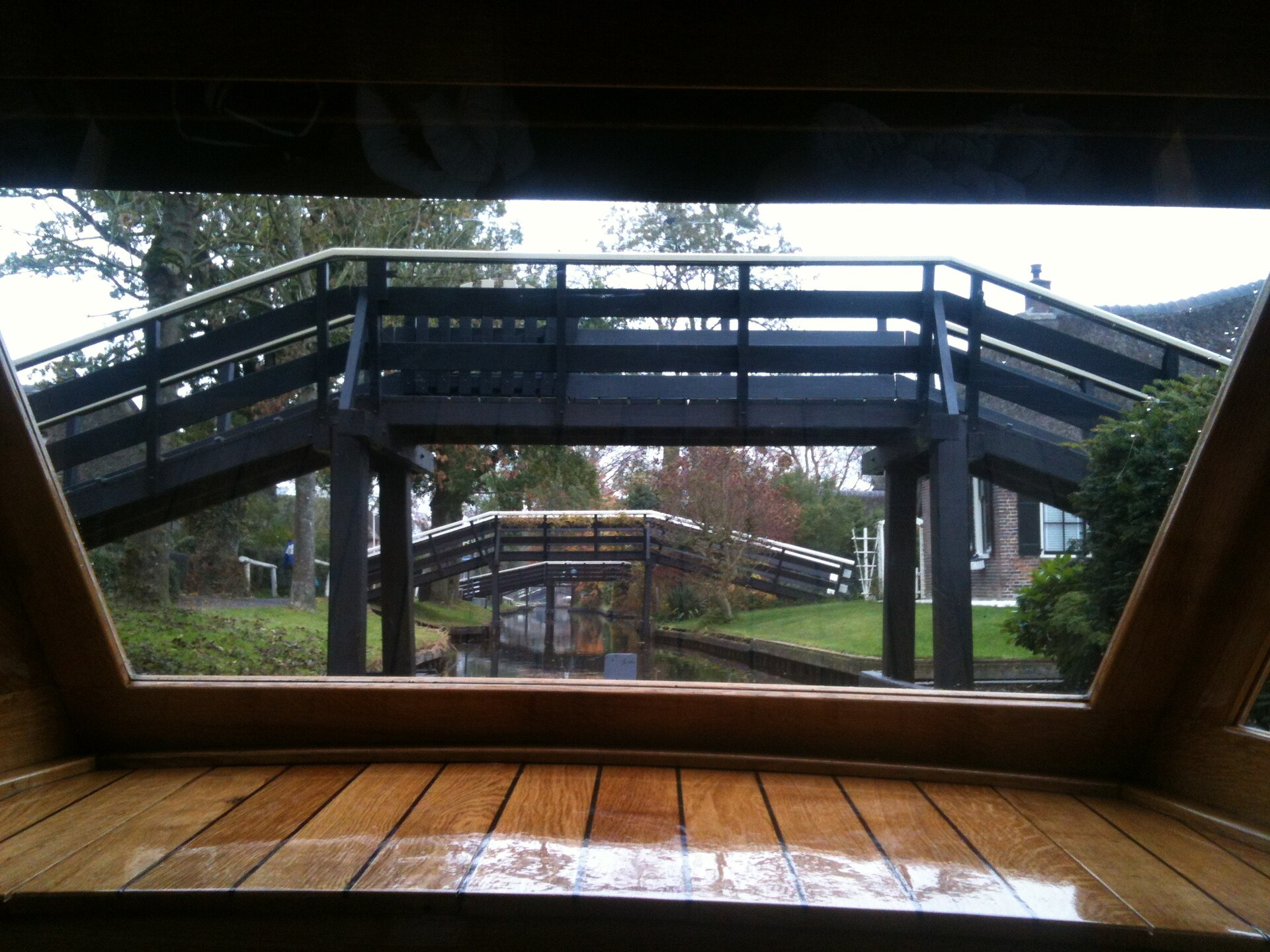
This is a research-based piece: I have not been to Giethoorn, and everything here comes from published sources, linked at the end. But the facts are strange enough on their own. Giethoorn is a village of around 2,800 people in Overijssel, in the north-east of the Netherlands, about 120 km from Amsterdam. In its old centre there are no roads at all. Houses stand on small islands, linked by some 176 wooden footbridges, and the only way from one end of the village to the other is by boat, on foot, or by bicycle along a single path. It is often called the “Venice of the North” — though unlike Venice, it was never meant to be like this. The canals were not built for beauty. They were dug for fuel.
Giethoorn was founded around 1230, and its name is a clue to its beginnings. The first settlers found large numbers of goat horns buried in the boggy ground — reputedly the horns of wild goats drowned in a flood in 1170 — and the settlement was first recorded as Geytenhoren, or “goat’s horn”. The land itself was peat: thick, spongy soil made of partly decayed plants, and for centuries peat was the village’s livelihood. People cut it, dried it, and sold it as fuel.
Peat is heavy and awkward to move, so from around the 16th century the villagers began digging narrow channels to float it out. Over generations those channels were widened, linked and multiplied until the whole village was threaded with water. The digging also hollowed out the countryside: the broad, shallow lakes around Giethoorn, including the Bovenwijde, are in large part holes left behind by people with spades. Peat digging carried on until around 1920, and by then the village had become something nobody had planned — a place where the roads were water.
Daily life in Giethoorn runs on the water. The main canal, the Dorpsgracht, runs for about 4 km through the village, and most houses sit on their own little island with a private wooden bridge to the footpath. There is a cycling path now, and cars can reach the newer parts of the village, but the old centre is still car-free — deliveries, visits and the school run all happen by boat or on foot. The postman has traditionally come by boat too, which must make the daily round either the most peaceful or the most weather-dependent postal job in the Netherlands.
The boats themselves are part of the charm. The traditional craft is the punter, a flat-bottomed wooden boat once pushed along with a long pole, and today most rental boats are fitted with whisper-quiet electric motors — hence the nickname “whisper boats”. They top out at about 6 km per hour, which is roughly walking pace, and you do not need a boating licence to hire one. The silence is the point: without engines roaring or traffic humming, you hear ducks, reeds and your own conversation, which is a rare thing in a tourist spot.
For seven centuries Giethoorn was a quiet working village of peat cutters, fishermen and reed harvesters. Then, in 1958, the Dutch director Bert Haanstra chose it as the setting for his comedy Fanfare, and the village became famous almost overnight in the Netherlands. The film is a gentle farce about a village brass band that splits into two rival bands, and Haanstra shot it on location among the canals and thatched farmhouses. It was one of the most successful Dutch films of its time, and it turned a place most Dutch people had never heard of into a national postcard.
The fame stuck, and then it grew. Tourism is now the village’s main business, with the busy season running from April to October, and the village draws visitors from far beyond the Netherlands — Chinese tourists in particular have become a familiar sight on the canals. The trade-off is real: on a summer afternoon the narrow waterways can feel crowded with rental boats, and residents have had to learn to live with strangers photographing their front gardens. The local advice is to go early or late — the water is quietest before 10 in the morning and after 4 in the afternoon — and the village sits on the edge of the Weerribben-Wieden National Park, the largest freshwater wetland in north-western Europe, so the quiet is never far away.
Here is the detail that stays with me: Giethoorn was its own municipality until 1973, when it was folded into the larger municipality of Steenwijkerland — a village that spent 700 years governing itself from the water, only to be merged on paper by people who arrived by road. The canals are still there, the bridges are still counted in the hundreds, and the boats still whisper past thatched roofs at walking pace. Some places are built around roads. Giethoorn is a reminder that a village can be built around the absence of them — and work perfectly well.
Related on Poptani Labs: Baarle: the town where the border runs through your front door, Silbo Gomero: the island where people whistle across valleys. More in this category: Around the World.
Sources: Giethoorn — Wikipedia, Giethoorn — Wikivoyage, Giethoorn: A Gentle Guide to the Dutch Village Without Roads — Senior Travel With Us, Boating in Giethoorn: boat hire and canal cruises — Giethoorn.com, Finding peace on a “whisper boat” — Heritage Vietnam Airlines

