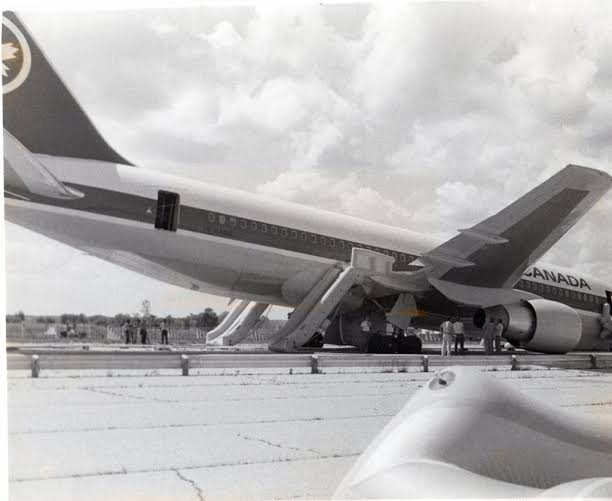
On July 23, 1983, Air Canada Flight 143 — a brand-new Boeing 767 flying from Montreal to Edmonton with a stop in Ottawa — did something no airliner is supposed to do. It ran out of fuel at 41,000 feet (12,500 metres) and turned into a 132-tonne glider. Sixty-nine people were on board. What saved them was a string of coincidences so improbable it reads like a screenplay: a captain who flew sailplanes for fun, a co-pilot who happened to have trained at a decommissioned airbase directly below them, and a landing gear failure that turned out to be the best thing that could have happened.
Canada was mid-transition to the metric system, and the 767 was Air Canada's first all-metric aircraft — its computers counted fuel in kilograms. But the fuel-quantity indicator system (FQIS) on this particular jet, C-GAUN, was broken. So the crew measured fuel the old way, with a dripstick — essentially a dipstick that gives you volume in litres, which you then convert to mass.
That's where the chain broke. The refuelling slip on the clipboard used the density of jet fuel in pounds per litre (1.77) — the figure for the rest of the imperial fleet. The correct figure for a metric aircraft was kilograms per litre (0.80). The crew did the arithmetic three times, got the same answer, and took off with roughly 45% of the fuel they needed.
Sources: Wikipedia — Gimli Glider, summarising the Lockwood Board of Inquiry report (April 1985)
Over Red Lake, Ontario, the cockpit warning system chimed four times: a fuel-pressure problem on the left side. The pilots assumed a failed pump and silenced it. Seconds later the right side sounded. They diverted toward Winnipeg — and then the left engine flamed out, followed by the right. Nobody in the cockpit had ever heard the "all engines out" warning sound before, and the emergency checklist had no section for flying with both engines dead. It had simply never been considered possible.
The 767's glass-cockpit screens went dark. A small ram air turbine dropped out of the belly to give them just enough hydraulic power to steer. The plane glided — for 17 minutes.
First Officer Maurice Quintal did the glide math from the backup instruments and realised Winnipeg was out of reach. Then he remembered: Gimli, a closed Royal Canadian Air Force base where he had once trained, lay within range. What nobody told him — or air traffic control — was that part of the base had been converted into the Gimli Motorsports Park. A sports-car race was underway. The decommissioned runway was full of cars, campers, and spectators.
As the silent 767 dropped toward the runway, the crew realised they were too high and too fast — and with no engine power, there was no going around. Captain Bob Pearson, an experienced sailplane pilot, did what glider pilots do: a forward slip, crossing the controls to drag the aircraft down steeply without gaining speed. It's a bread-and-butter move in a tiny sailplane. It is almost unheard of in a 130-tonne airliner.
Without hydraulics, the crew lowered the landing gear by gravity drop. The mains locked. The nose wheel didn't. The plane touched down, the unlocked nose slammed into the tarmac and collapsed — and that became a gift. The scraping nose, plus a guardrail running down the centre of the repurposed drag strip and two blown tyres from Pearson's hard braking, scrubbed off speed fast enough to stop the aircraft before it reached the crowds. The guardrail even helped: the main gear straddled it, keeping the plane tracking straight.
Result: zero fatalities, zero serious injuries. Ten passengers suffered minor injuries, mostly exiting the rear slides, which were shorter than needed because the collapsed nose had tipped the tail up. The aircraft itself was repaired and flew for Air Canada for another 25 years — until its retirement in 2008 — as the "Gimli Glider."
Source: Wikipedia — Gimli Glider
Two boys were riding bicycles within 1,000 feet of the point where the 767 was about to touch down. With both engines dead, the aircraft made almost no sound — the crowd had no warning. The boys simply pedalled away as the biggest glider in the world bore down on them. And after it stopped? Racers and course workers grabbed portable fire extinguishers and put out a small nose fire. Then, presumably, everyone went home and told a story nobody believed for years.
The Gimli Glider is usually told as a miracle, but it was really a layered system: a units error created the emergency, and a stack of unlikely human preparations resolved it. Pearson's hobby, Quintal's old posting, and even a broken nose gear — each useless or dangerous on its own — stacked into a save. The industry's takeaway was procedural: assign fuel-load responsibility clearly, train metric properly, keep spare sensors in stock. But the human takeaway is warmer. The reason 69 people lived is that the right two people, with the right odd backgrounds, were in the cockpit on that particular Saturday evening — and when the checklist ran out, they improvised like it was exactly the job.

