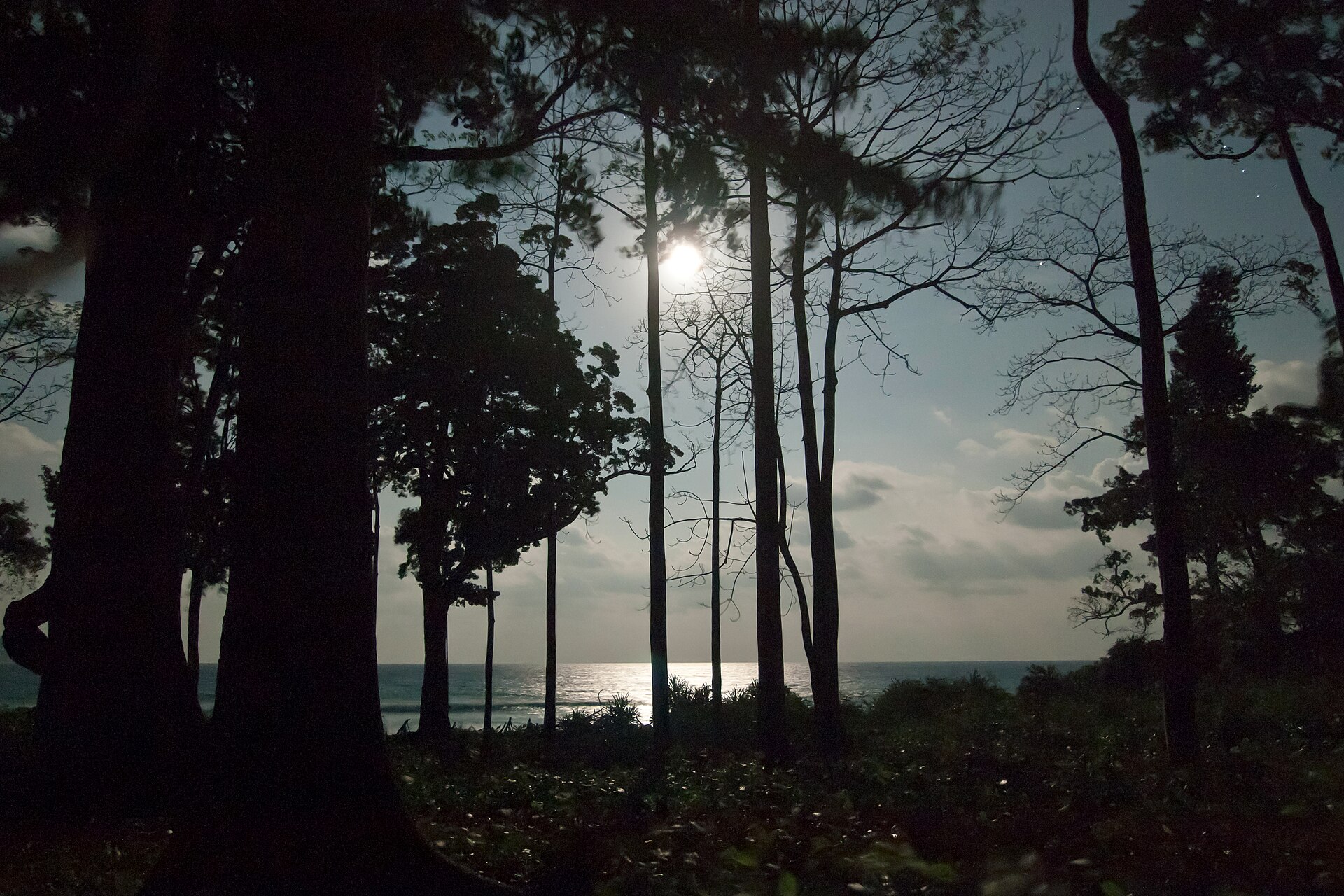
Imagine waking up to a sky with no Moon — no crescent, no full disc, no moonlight at all. It would not end the world overnight. But the Moon quietly runs several of Earth's systems, and removing it would change the planet on every timescale, from tonight to millions of years from now. This piece is research-based, built from published astronomy writing rather than any experiment we could run, so where scientists disagree or the outcome is far-future, we say so plainly.
The first thing you would notice is at the coast. The Moon's gravity pulls the oceans toward it, creating the bulge of water we experience as high tide. Without the Moon, tides would not disappear entirely, because the Sun pulls on the oceans too — but the Sun's tidal pull is only roughly half the Moon's, so tides would shrink to about half their current size or less.
The dramatic extremes would go first. Spring tides — the especially high and low tides that occur when the Sun, Moon, and Earth line up — would vanish, because they depend on the two pulls combining. Places famous for enormous tidal ranges, like the Bay of Fundy in Canada and Mont-Saint-Michel in France, would lose the spectacle that defines them; their tidal ranges would collapse toward the modest solar-only rhythm. Coastal ecosystems that depend on the twice-daily wash of the tide — mudflats, salt marshes, intertidal feeding grounds — would have to adjust to a gentler, simpler cycle.
The second immediate change would be darkness. Moonlight is the brightest thing in the night sky by a huge margin, and without it, nights would be far darker — stars would blaze, but the landscape would go black. For humans that is mostly a matter of mood and stargazing. For wildlife, it is more serious.
Many nocturnal animals navigate and hunt by moonlight. Moths use the Moon as a distant compass; turtle hatchlings find the sea partly by heading toward the brighter horizon over the water, a cue moonlight strengthens. Take the Moon away and these behaviours lose their reference point — not catastrophically in a single night, but as a persistent pressure on species that evolved under a moonlit sky. This is speculation in its details, but the direction is clear: a darker night is a different night.
Here is a subtler effect. The Moon's tidal pull drags on Earth's rotation like a gentle brake, lengthening the day by roughly 2 milliseconds per century. That sounds trivial, but run it backwards and it is enormous: early Earth spun so fast that a day lasted only about 4 hours. The Moon's braking, acting over billions of years, stretched those days out to the 24 hours we live by.
If the Moon vanished, the braking would stop. Days would stop lengthening — they would stay close to 24 hours rather than continuing their slow stretch. Nothing you would notice in a lifetime, but it is a reminder of how much of Earth's current rhythm is a gift from its companion.
The slowest and strangest consequence concerns Earth's tilt. Our planet leans at 23.5 degrees, and that lean gives us seasons. The Moon's gravity acts like a stabiliser, holding that tilt steady. Without it, the tilt would wander over long timescales, wobbling far more than it does today — and as the tilt changed, so would the seasons, drifting into patterns no civilisation has ever experienced.
This is the far-future, speculative end of the story: over millions of years, a Moonless Earth could swing between much more extreme climates, with ice ages and heat extremes driven by a wandering axis. It would not make Earth uninhabitable overnight — that part is speculation, and scientists debate the details — but it would make the long-term climate far less predictable than the one we inherited.
Apollo astronauts left laser reflectors on the Moon, and scientists still bounce lasers off them today to measure the Moon drifting away at about 3.8 cm per year — the most precise ruler in the solar system, left behind in 1969. The Moon is already leaving us, very slowly; a Moonless Earth is not a fantasy scenario so much as the far-distant end of a process already underway.
So: no Moon, no immediate apocalypse — but a smaller-tided, darker, and eventually less stable world. The thought experiment is really a lesson in how much quiet work one neighbour does: it paces our tides, lights our nights, brakes our days, and steadies our seasons. The next time you look up and see it, consider that Earth without it would still spin, still have oceans, still have life — but it would be a different planet in ways both obvious and profound. If you want to see what the real night sky looked like on a date that mattered to you, our Your Day in the Cosmos tool reconstructs it, Moon included — and World Live lets you watch the planet's live rhythms, from quakes to the space station overhead, right now.
Astronomy — What if the Moon disappeared tomorrow?
Biology Insights — How would tides be affected by the absence of the Moon?
ScienceABC — What will happen to ocean tides when the Moon moves away?

