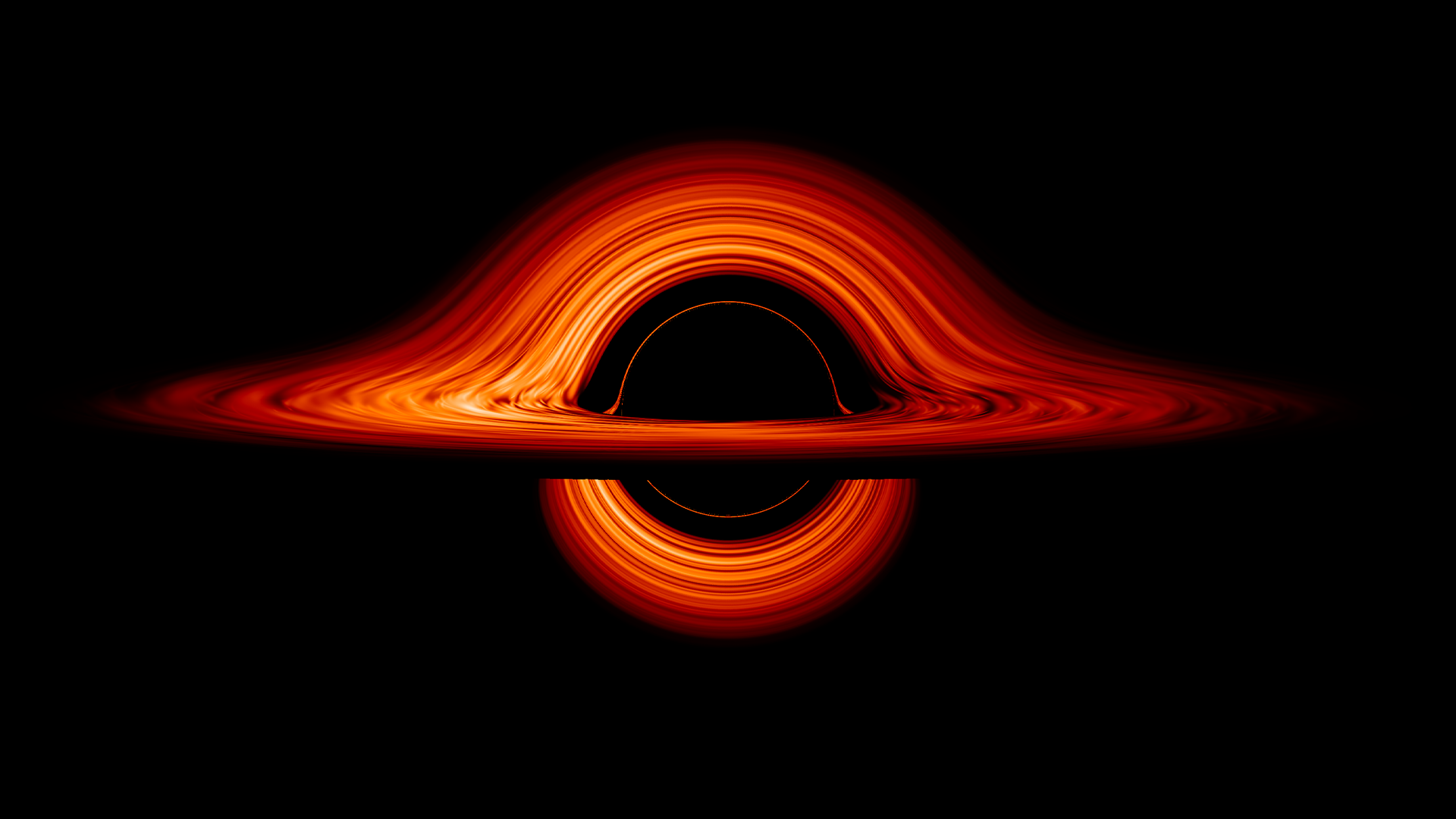
Spoilers ahead for a film from 2014 — if you haven't seen it yet, watch it first. Most blockbuster endings work by going bigger: a larger battle, a louder explosion. Interstellar ends by going smaller — a father, a daughter, a bookshelf, and a wristwatch. And it lands harder than any explosion, because the ending doesn't introduce a new mystery. It solves the one the film opened with.
Running out of fuel near the black hole Gargantua, Cooper detaches his craft so Brand can reach Edmunds. He falls into the black hole — and instead finds himself inside a tesseract: a structure built by future, five-dimensional humans, rendered as an endless lattice of Murph's childhood bedroom, at every moment of her life. Gravity, the one force that can cross dimensions, lets him reach back through time. He sends Murph the quantum data she needs — tapped out in Morse code through the second hand of the watch he gave her — and she solves the gravity equation that lets humanity leave a dying Earth. Cooper is ejected, found near a space station, and reunited with Murph, now an old woman. She sends him on his way to find Brand.
Source: MovieWeb
Rewatch the first act with the ending in mind and the film quietly reassembles itself. The "ghost" knocking books off young Murph's shelf, the dust settling into coordinates on her bedroom floor, the message begging him to stay — all of it was Cooper, reaching back through the tesseract. The coordinates led him to NASA. The stay message was him begging himself not to leave. The film's first act is its final act, seen from the wrong end.
That loop is why the ending feels earned rather than clever. A twist that only surprises you works once; a twist that reframes everything you watched rewards a second viewing. And the loop has a human engine: Cooper can only find Murph across time because of his bond with her — the film's argument, made by Brand mid-journey, that love reaches across time and space. You can read that as hard science fiction (gravity literally crossing dimensions) or as sentimentality dressed as physics, and the film supports both readings. What isn't in doubt is the cost: every hour of the mission cost Cooper years of his children's lives.
The film is ruthless about time dilation, and that ruthlessness is what the ending cashes in. On Miller's planet, near Gargantua's gravity, one hour on the surface equals seven years back on Earth. Cooper leaves two children and comes home to a daughter older than he is. So the reunion scene isn't a happy ending — it's a scene between a father who missed his daughter's life and a daughter who spent that life finishing his work. When elderly Murph tells him to go find Brand, it's not rejection; it's the completion of the exchange. He gave her the data; she gives him permission to live the rest of his life.
Part of the ending's power is that its wildest visuals are grounded in real physics. Physicist Kip Thorne, the film's science advisor, set two rules: nothing could break established physics, and every speculation had to grow out of real science. The black hole Gargantua was rendered from Thorne's equations by the effects studio Double Negative, which had to build a new renderer — ordinary ray-tracing couldn't handle light bending through curved spacetime. Some individual frames took up to 100 hours to render, and the work was published as a paper in the journal Classical and Quantum Gravity in 2015. When the Event Horizon Telescope photographed a real black hole in 2019, the dark shadow ringed by warped light looked like what the film had predicted five years earlier.
But the film is honest about the boundary, too. The black hole, the time dilation, and the spinning ship are sound; the wormhole, the tesseract, and the beings who built them are speculation — plausible extensions of the equations, not established fact. That honesty is part of why the ending holds up: it never asks you to believe the fantasy, only to feel what it would mean if it were true.
Sources: Animation World Network, Screen Rant, Abakcus
Here's the detail that sums up the film's approach: for the Cooper family farm, director Christopher Nolan refused CGI corn and planted roughly 500 acres of the real thing near Calgary, Alberta — after consulting Zack Snyder, who had grown a large cornfield for Man of Steel. The crop grew well, the production harvested it after filming, and Nolan later said they actually made money on it. A film about humanity leaving Earth took the trouble to grow a real farm first. That insistence on the tangible is why the ending's most fantastical scene — a man floating through time inside a bookshelf — feels so grounded.
Source: SlashFilm
Endings usually ask: did the hero win? Interstellar asks something harder: what did winning cost, and was it worth it? Cooper saves humanity and loses his daughter's childhood; Murph saves humanity and loses her father to the mission. The film's final image isn't a victory lap — it's a man setting off again toward someone waiting on a distant planet. That's why the ending stays with people a decade later. It doesn't resolve into triumph or tragedy. It resolves into a loop closed by love, a debt paid in time, and a father and daughter who understand each other — across a lifetime neither of them got to share.

