Put a bowl of leftovers in a microwave, press start, and two minutes later it is hot — but the plate is cool, the middle is still cold, and the edges are scalding. A conventional oven heats food from the outside in. A microwave does something stranger: it heats the food from the inside, by shaking its water molecules with invisible radio waves. The trick was discovered by accident in 1945, when a radar engineer's snack melted in his pocket.
At the heart of every microwave is a magnetron, a vacuum tube that generates microwaves — radio waves at a frequency of about 2.45 gigahertz. Those waves pass into the food and are absorbed mainly by water, fats, and sugars, whose molecules twist and vibrate in time with the field. The vibration is heat. Because microwaves only penetrate a few centimetres, the outside cooks first and the heat spreads inward by conduction — which is why the middle of a thick portion stays cold while the edges boil. The waves also form standing patterns inside the metal box, creating hot spots and cold spots; the rotating turntable exists to move the food through them.
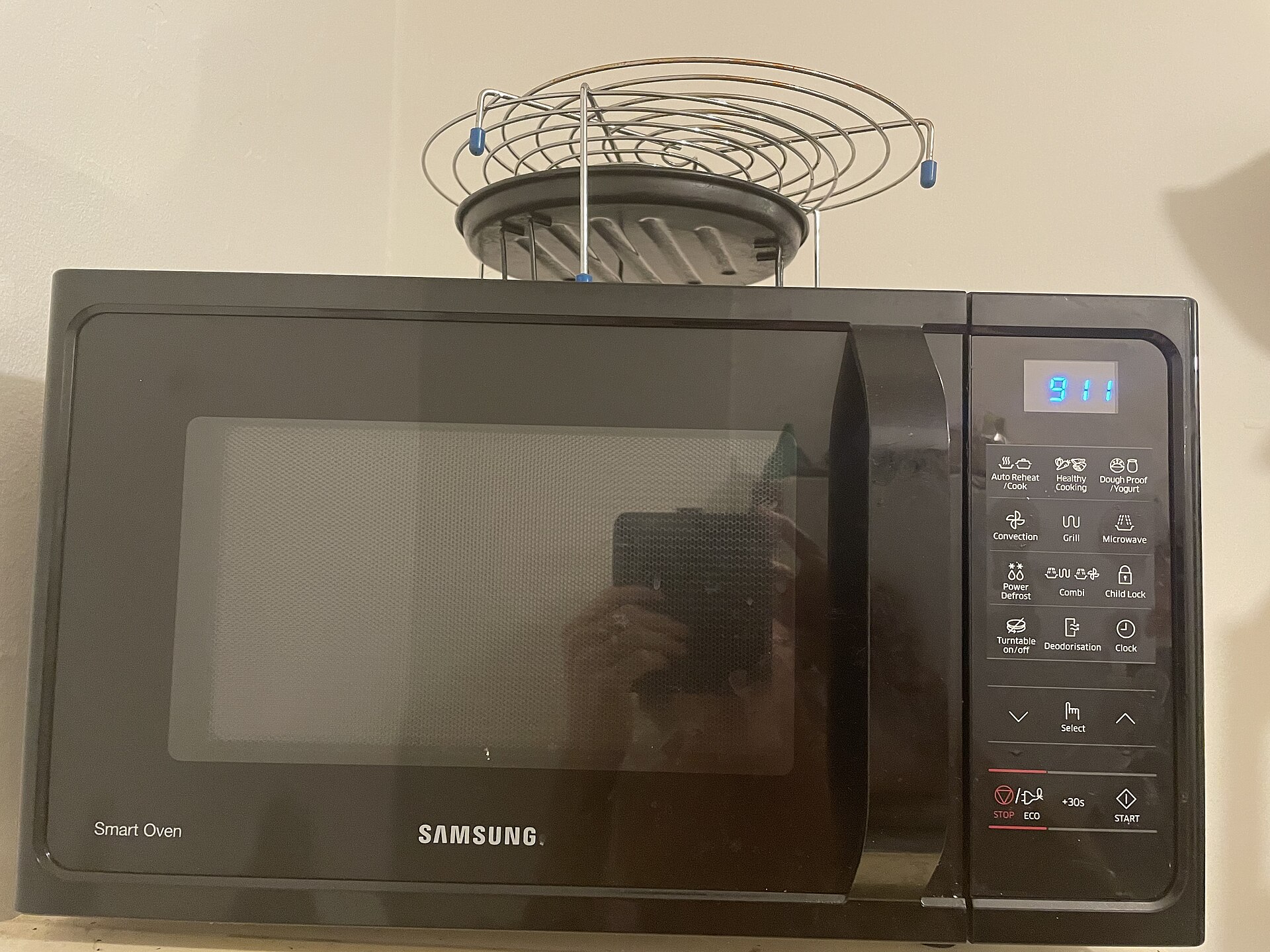
The inside of a microwave is a metal box, and metal reflects microwaves instead of absorbing them. That is the point — the box keeps the waves in. But a piece of metal inside the box reflects the waves back at odd angles, concentrating them until the electric field is strong enough to ionise the air: a spark. Thin edges and points concentrate the field most, which is why a fork crackles and a crumpled sheet of foil can arc. The little mesh in the door window works on the same physics in reverse: its holes are smaller than the wavelength of the microwaves, so the waves cannot get out — but visible light, with a far shorter wavelength, passes through, and you can watch your food.
The discovery belongs to Percy Spencer, a self-taught engineer at the American defence company Raytheon. In 1945, while working near a magnetron — the tube that powered Allied radar — Spencer noticed that a candy bar in his pocket had melted. Instead of shrugging, he tested the effect deliberately: popcorn kernels popped in front of the magnetron, and an egg, placed in a kettle with a hole cut in it, exploded. Raytheon filed a patent for cooking with microwave energy on October 8, 1945; it was granted in January 1950 as US patent 2,495,429. The first commercial oven, the Radarange, arrived in 1947.
Microwaves are non-ionising radiation: they cannot make food radioactive, and they cannot damage DNA the way X-rays can. What they cannot do is brown or crisp. Browning needs a hot, dry surface, and a microwave heats by shaking water, which keeps surfaces at around the boiling point of water. That is why microwaved bread goes soft and microwaved pizza needs a crisping tray. It is also why the appliance is best at what it was first sold for: reheating, defrosting, and cooking things that are mostly water.
A microwave oven is a radar tube in a metal box, pointed at your lunch. It works because water is very good at absorbing a very specific frequency of radio wave, and because one curious engineer, faced with a melted snack, asked why instead of reaching for another one. Every time your food comes out hot at the edges and cold in the middle, you are watching the same physics that won a war — and a patent — in 1945.
Related on Poptani Labs: How a website actually works: from typed address to page on your screen, How a QR code survives scratches, smudges and a bad camera angle, Why 'turn it off and on again' actually works (and when it doesn't). More in this category: Built in the Lab.
Sources: History.com, who invented the microwave oven?, Inc., how a Raytheon scientist accidentally invented the microwave oven, ScienceBlog, Percy Spencer and the accidental discovery

