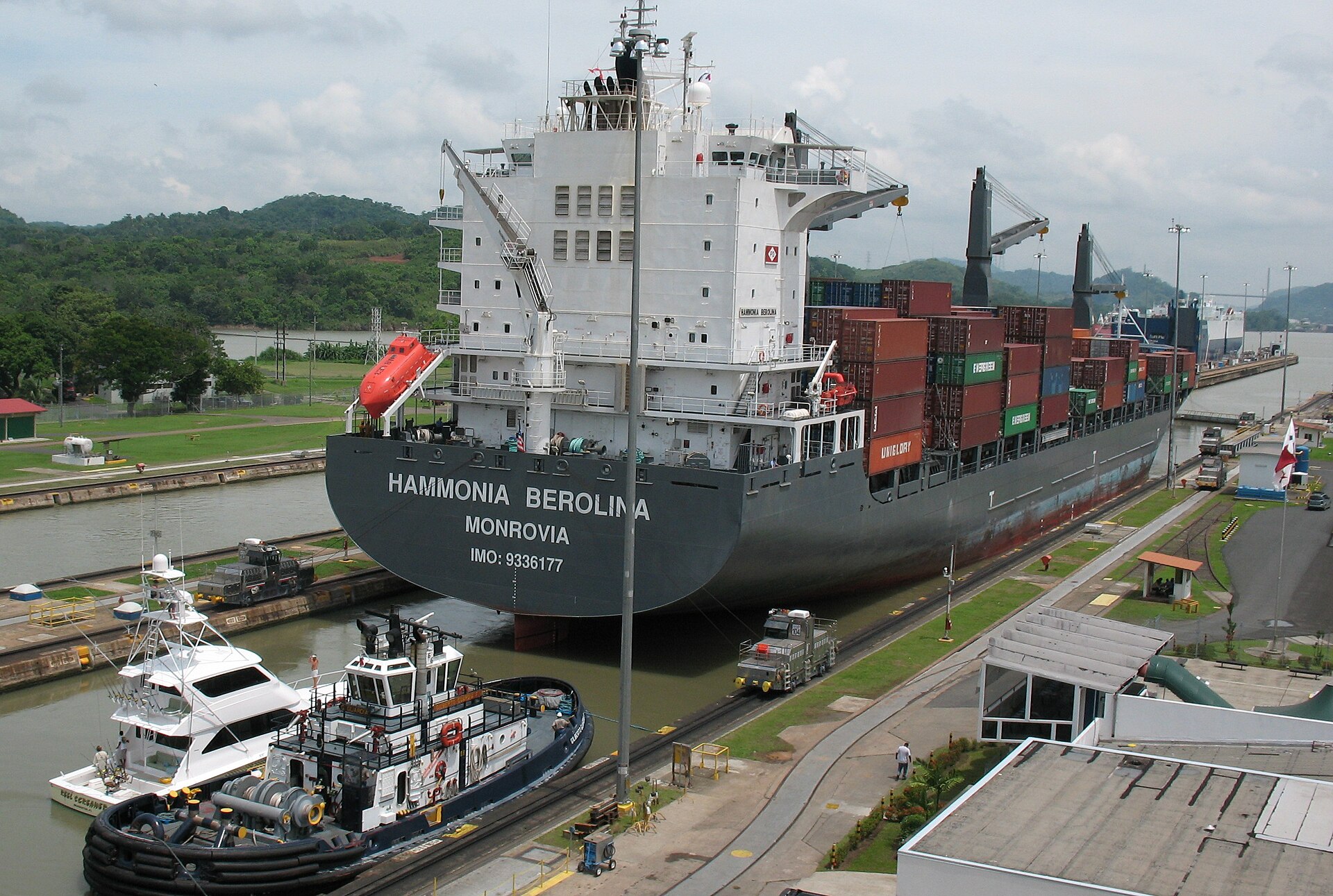
Most people picture the Panama Canal as a sea-level ditch cut through jungle. It is nothing of the sort. The canal is a staircase of locks that lifts ships 26 metres over a continental divide — and every step up is powered not by seawater, but by rain. This piece is research-based, drawn from published reporting on the canal's recent drought years rather than any visit or measurement of our own, and every number below comes from those sources.
Opened in 1914, the canal runs 51 miles across the Isthmus of Panama, joining the Atlantic and Pacific. The shortcut saves ships roughly 8,000 miles and up to about 22 days compared with sailing around South America — which is why it carries a large share of world trade, and why its story matters far beyond Central America. (If you want the longer version of how container shipping reshaped the world economy, our piece on how the shipping container changed the world is the place to start.)
The engineering is the catch. Ships do not sail through the canal; they are lifted through locks by water flowing downhill from Gatun Lake, a vast artificial reservoir in the middle of the isthmus. Each transit through the original locks releases around 200 million litres of that freshwater to the sea. The canal, in other words, spends a small lake's worth of rain on every ship that passes — and it can only spend what the watershed collects.
In 2023, the rain did not come. That year was the second-driest in the canal's 73-year record, with rainfall roughly 30% below normal, driven by El Niño. Gatun Lake fell, and the canal authority had to ration its water the only way it could: by rationing ships.
Daily transits were cut from the usual 38 down to about 22–24, and the maximum draft — how deep a loaded ship may sit in the water — was limited to below 44 feet, forcing the biggest vessels to carry less cargo or wait. Ships queued, schedules slipped, and some cargo was rerouted around the Americas or through other routes entirely. The timing made it worse: the squeeze coincided with security problems in the Red Sea, so two of the world's great shortcuts were under strain at once, compounding stress across global shipping.
The canal fought back with engineering. New water-saving basins, built alongside the expanded locks, recycle roughly 60% of the water used per transit, letting each transit spend far less of the lake. Through 2025 the system recovered: daily transits climbed back to near 36, and the full 50-foot draft for the largest Neopanamax ships was restored. For a while, the crisis looked like a closed chapter.
It was not. In September 2026, with an El Niño watch returning, fresh restrictions came back: daily transits were cut first to 34, then to 32. The pattern is now familiar — recovery, then relapse with the next dry cycle — and it is why the canal authority is pursuing a longer-term answer: the Río Indio Reservoir project, under the Agua del Futuro programme, which would add a new water source to the watershed rather than rationing the existing one harder each time.
Every ship through the old locks spends a small lake's worth of fresh water — about 200 million litres per transit, dropped to the sea — which is why a drought in one small Central American watershed can reroute cargo on the other side of the planet. The canal is often described as a marvel of concrete and steel. It is just as accurately described as a marvel of rainfall management — and rainfall, unlike concrete, cannot be ordered on schedule.
The Panama Canal's drought years are a preview of a wider problem: the infrastructure of global trade was built for a climate that is no longer guaranteed. A canal that runs on rain, ports threatened by rising seas, rivers that carry cargo only when they are full — all of them assume weather patterns that are shifting. The canal's answer so far has been a mix of rationing, recycling, and a new reservoir, and whether that mix holds through the next El Niño will be watched by shippers everywhere. Trade, it turns out, does not just depend on ships and ports; as with the forces that move money itself — see our piece on why the US dollar matters — it depends on systems far from the docks that most of us never think about, until they stop working.
gCaptain — El Niño watch puts Panama Canal back in focus after dramatic drought recovery
AI Timeline — Panama Canal drought history timeline
All About Shipping — Panama's water future: securing the canal, strengthening global trade
Kuehne+Nagel — Panama Canal cuts transit capacity as El Niño returns

