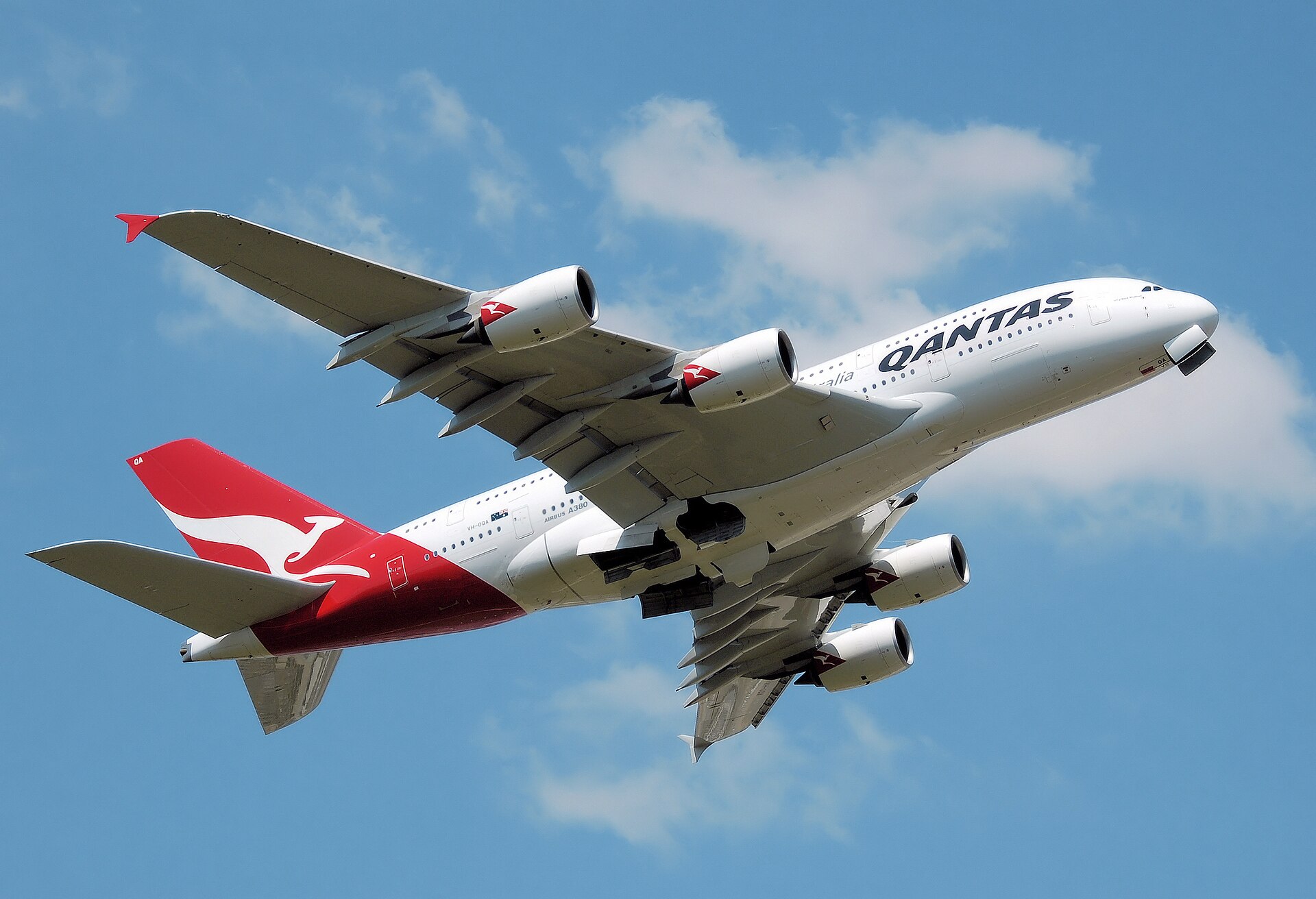
Four minutes after takeoff from Singapore's Changi Airport on 4 November 2010, the world's largest passenger jet was climbing through 7,000 feet when the crew heard two almost simultaneous loud bangs. One of the four engines on Qantas Flight 32 had just exploded — and the shrapnel it threw out went through the wing like a shotgun blast.
On board were 469 people: 440 passengers and 29 crew. The aircraft was VH-OQA, an Airbus A380 named Nancy-Bird Walton after the Australian aviation pioneer, and the first A380 Qantas had ever taken delivery of. It was on the Singapore-to-Sydney leg of a London–Sydney service. What happened next is still studied in cockpits around the world as a masterclass in staying calm while everything fails at once.
The failure was in the No. 2 engine — the inboard engine on the left wing, a Rolls-Royce Trent 900. A turbine disc inside it disintegrated at high speed. In aviation language, this is an uncontained engine failure: the engine casing could not hold the debris, so high-energy fragments escaped sideways into the aircraft itself.
Sources: ATSB final report (AO-2010-089), Wikipedia — Qantas Flight 32
The debris tore into the nacelle, the left wing, the fuel system, the landing gear, and the flight controls. It knocked out one hydraulic system and the anti-lock brakes, pushed the other three engines into degraded mode, and severed the controls for the No. 1 engine. Fuel began leaking from the left wing. A fire started in a fuel tank — and, mercifully, put itself out before anyone knew it was there.
Some pieces of the shattered disc weighed as much as 70 kg, and fell on houses on Batam Island below, in Indonesia. Two people on the ground were reported to have minor injuries. Pieces that big missed the fuselage — and the 469 people inside it — by metres.
Sources: Australian Aviation — QF32, FAA Lessons Learned — VH-OQA
There were five pilots in the cockpit that day — Captain Richard de Crespigny in command, plus four others, including check and training captains who happened to be along for the ride. It turned out to be the luckiest coincidence in the story: five experienced heads to share a workload no two-person crew could have carried.
The crew held over the sea and worked through the failures one system at a time — figuring out what still worked, what didn't, and what the jet could still safely do. After roughly two hours of assessment and controllability checks, they turned back for Changi and brought the damaged A380 down in one piece. Nobody on board was injured.
Here's the part that sounds made up. After the jet landed, the crew discovered they could not shut down the No. 1 engine — its controls had been cut by the shrapnel. So the emergency didn't end at touchdown: the aircraft sat on the tarmac with one engine still roaring, fuel still leaking, and 440 passengers still strapped in.
Disembarkation was delayed for about an hour while firefighters assessed the risk. When passengers finally left, it was through a single exit, roughly two hours after landing. And the No. 1 engine? Firefighters finally stopped it by spraying firefighting agent directly into its inlet — three hours after the aircraft had landed. The jet that survived an exploding engine was eventually defeated by a fire hose.
Source: FAA Lessons Learned — VH-OQA
The Australian Transport Safety Bureau traced the explosion to something absurdly small. A number of oil feed stub pipes inside the Trent 900's high-pressure/intermediate-pressure hub assembly had been manufactured with wall sections thinner than the design specification — a machining error. On the No. 2 engine, a thin-walled pipe developed a fatigue crack, leaked oil, and started an internal fire. The fire let the intermediate-pressure turbine disc slip off its drive shaft; the freed disc spun out of control and burst apart.
Qantas grounded its A380 fleet. Other Rolls-Royce-powered A380s — at Lufthansa and Singapore Airlines — were inspected and had engines replaced. Rolls-Royce later shipped an engine-control software update with a turbine overspeed protection system designed to shut an engine down before a disc can overspeed again. The aircraft itself was repaired and returned to service.
Sources: ATSB final report (AO-2010-089), Hackaday — "A Few Millimeters Of Metal"
Close calls are easy to file under "luck" — and QF32 had its share. The disc fragments missed the fuselage by metres. The fuel-tank fire extinguished itself. Five pilots happened to be in the cockpit.
But most of what saved 469 people wasn't luck. It was a crew that had trained for the unthinkable, an airframe strong enough to absorb a shotgun blast and keep flying, and an investigation honest enough to trace a near-catastrophe back to a pipe wall a fraction of a millimetre too thin. Luck decides how bad your day gets. Preparation decides what you do with it.

