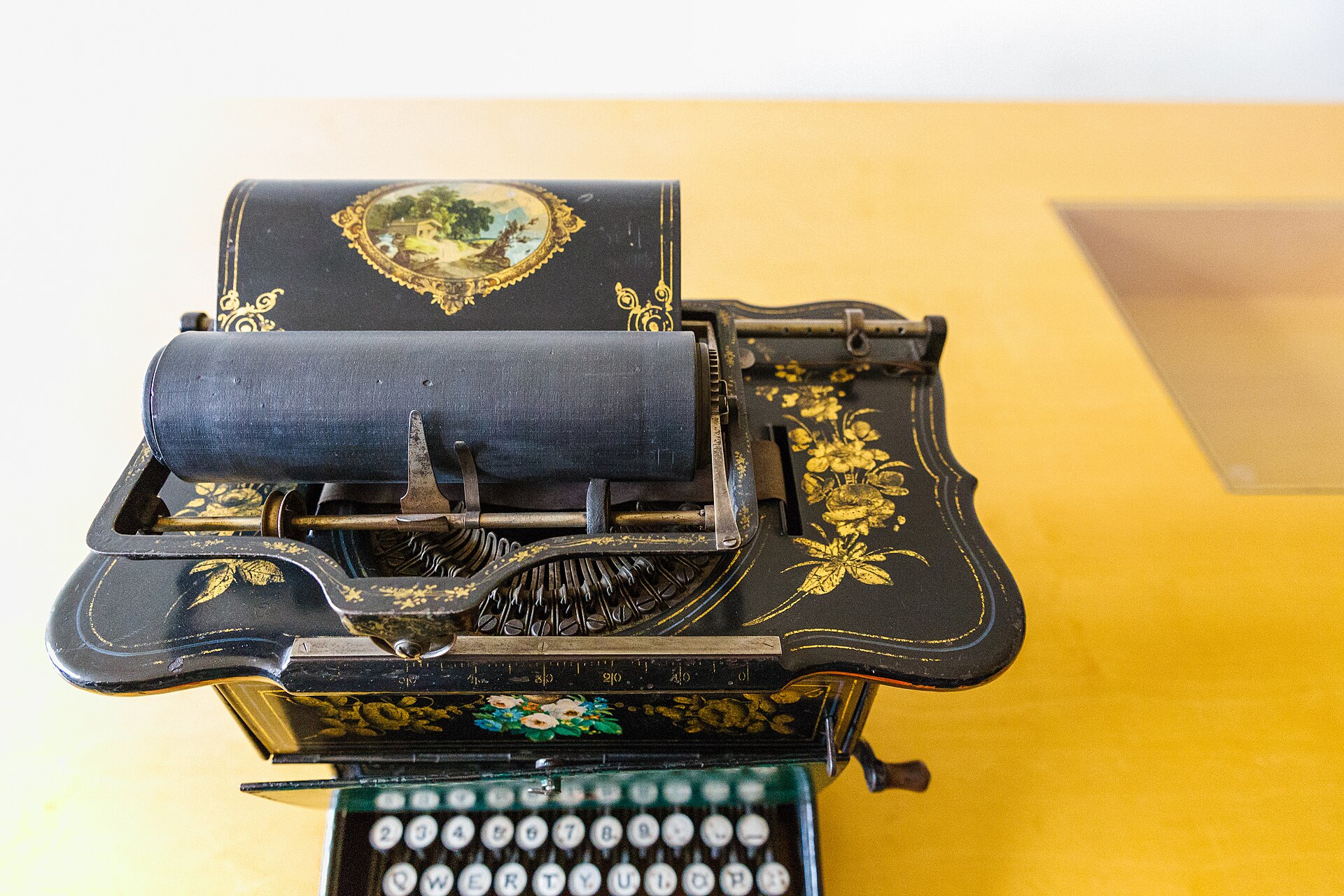
Look at your keyboard. The top row of letters reads Q-W-E-R-T-Y, and nothing about that order is alphabetical, ergonomic, or obvious. It is a fossil: a layout designed for a machine that jammed, standardised by a gun manufacturer, taught by typing schools, and then never replaced — even though the machine it was built for has been extinct for decades. Every email you type today runs on a decision made in Milwaukee in the 1870s.
The story starts with Christopher Latham Sholes, a Milwaukee newspaper editor and printer. With Samuel Soule and Carlos Glidden, he built an early typewriter whose first keyboards were arranged alphabetically, in two long rows like piano keys. He patented the machine in 1868. The problem was mechanical. Each key swung a metal arm — a typebar — up to strike an inked ribbon against the paper. Type two neighbouring typebars in quick succession and the arms collided and jammed, forcing the typist to stop and untangle them by hand.
The classic explanation is that Sholes rearranged the keys to keep commonly paired letters apart. By separating pairs like "th" and "he", he slowed down the collisions, giving each typebar time to fall back before the next one rose. In 1873 he sold the manufacturing rights to E. Remington and Sons, a firearms maker with precision machinery to spare. Remington refined the machine, released the Remington No. 1 in 1874 and the hugely popular No. 2 in 1878, and QWERTY went with it into offices across America.
But the neat story has challengers. Researchers Koichi Yasuoka and Motoko Yasuoka of Kyoto University traced the layout's evolution alongside its earliest heavy users — telegraph operators transcribing incoming Morse code — and argued that the arrangement owes at least as much to those operators' needs as to jamming. An alphabetical layout, they found, was slow and confusing for Morse transcription, and the shifting letter order tracked the operators' workflow. The honest version is that both forces probably shaped the layout: a machine with real mechanical limits, and the first professionals who used it all day. History rarely gives us one clean cause, and QWERTY is no exception.
By the time better layouts arrived, it was already too late. The most famous challenger, the Dvorak Simplified Keyboard, patented in the 1930s, put the most-used letters on the home row and promised faster, less tiring typing. Later studies have argued endlessly about how much faster, if at all. But speed was never the whole contest. Typing schools taught QWERTY, employers hired QWERTY typists, manufacturers built QWERTY machines, and each side of that triangle reinforced the others. Retraining millions of typists to save a few words per minute was a cost nobody wanted to pay, so the layout became a standard by sheer weight of habit — the classic case of a technology locked in not because it is best, but because it got there first and everyone learned it.
Electric typewriters removed the jamming problem entirely — IBM's Selectric, for instance, replaced individual typebars with a spinning typeball — and computers removed every mechanical constraint that remained. QWERTY sailed on regardless, onto computer keyboards, laptops, and then, improbably, onto phone screens, where thumbs peck at a layout designed for ten fingers on metal arms. Alternative layouts survive as options on most devices, and a small community of enthusiasts swears by them. The rest of us type QWERTY without thinking, which is exactly the point: the layout won by becoming invisible.
QWERTY endures because standards are social, not just technical. A small fix for jamming typebars, amplified by a manufacturer's distribution, a profession's training, and a century of muscle memory, became the default for billions of people who have never seen a typebar. The next time a design choice feels permanent and inevitable, it is worth asking whether it is actually the best option — or just the one that got taught first.
Related on Poptani Labs: How a website actually works: from typed address to page on your screen, How a steel box rewired the world, How to run AI locally on your computer. More in this category: The Butterfly Effect.
Sources: Smithsonian Magazine, on QWERTY's contested origins; ScienceABC, history of the QWERTY layout; BBC History Magazine Q&A; MIT, early typewriter history

