Terence McKenna was an ethnobotanist, a mystic, and one of the great storytellers of the psychedelic age. Across hundreds of recorded lectures and books like Food of the Gods (1992), he asked one audacious question more insistently than anyone: what if human consciousness — language, art, religion, culture — had a chemical catalyst? His answer became his most famous idea: the "stoned ape" theory.
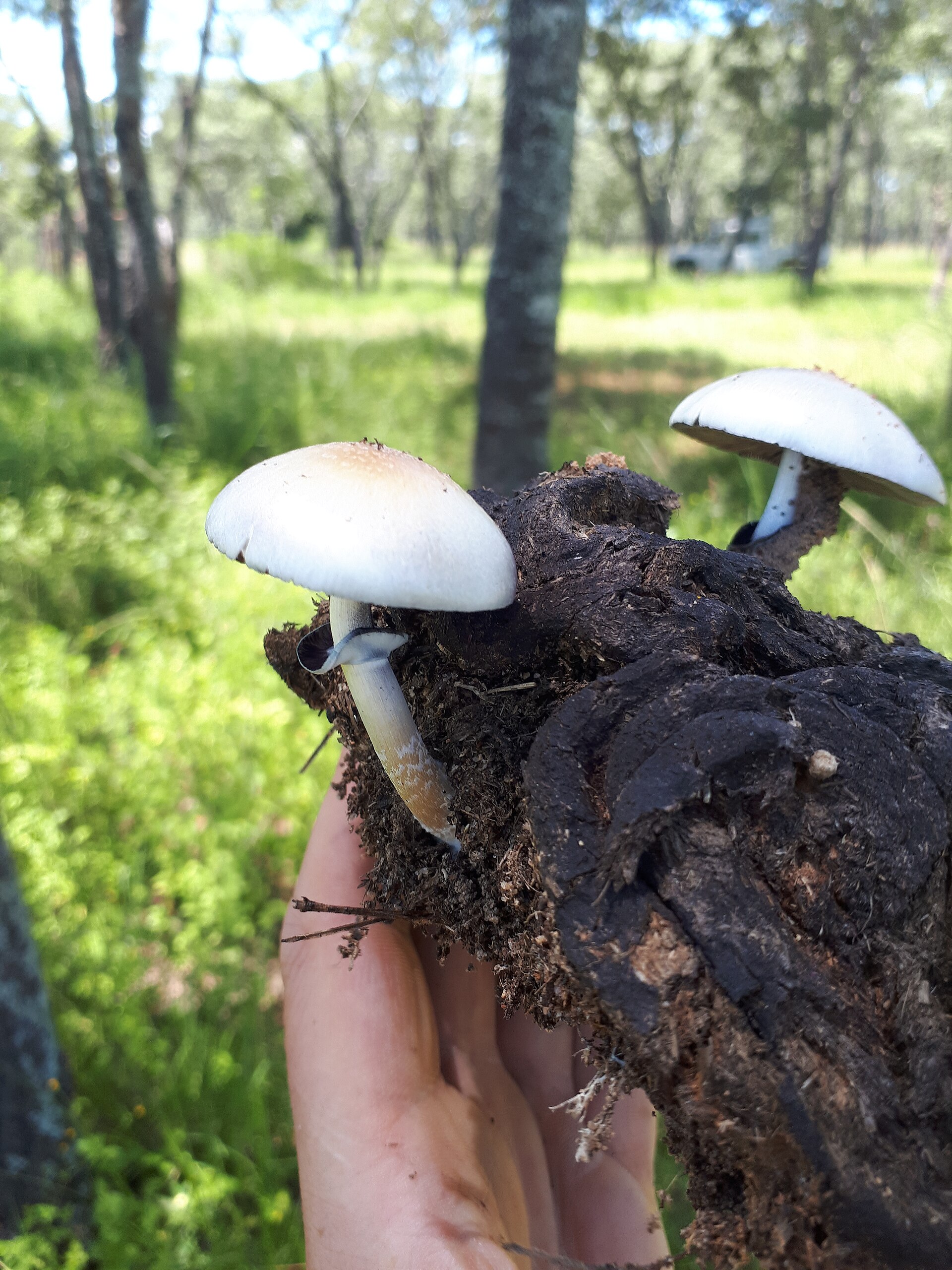
McKenna's argument starts with climate. Around 100,000 years ago, he says, the desertification of Africa pushed early humans out of shrinking tropical forests and onto the savanna, where they followed cattle herds for food. And wherever cattle leave dung, a certain mushroom thrives: Psilocybe cubensis, a psilocybin-bearing fungus that fruits directly from cowpats.
McKenna claimed the mushroom's effects worked on three rungs. At low doses, psilocybin sharpens visual acuity — better hunters bring home more food, and better-fed groups have more children. At slightly higher doses, it increases arousal and social bonding — more mating, tighter groups. And at high doses, it does something stranger: it floods the brain's language-forming regions with activity. McKenna pointed to the glossolalia — the "speaking in tongues" — often reported during intense psilocybin sessions, and suggested it was a kind of proto-language, the raw babble from which real language eventually crystallised. The same high doses dissolved the ego and the boundary between self and tribe, giving humanity, he argued, its first religious impulse.
His conclusion was total: psilocybin was the "evolutionary catalyst" from which language, projective imagination, the arts, religion, philosophy, science — all of human culture — sprang.
Sources: Wikipedia — Stoned ape theory, Psychedelic Science Review
Honesty requires saying this plainly: the stoned ape theory is not accepted by mainstream science. McKenna built it largely on studies by Roland L. Fischer from the 1960s and '70s, and critics say he misunderstood Fischer's findings. There is no direct archaeological evidence that early hominins regularly ate psilocybin mushrooms, and many anthropologists consider attributing brain growth to a single molecule an oversimplification of an extraordinarily complex evolutionary process.
But the idea has defenders too. McKenna's own brother Dennis — an ethnopharmacologist — has revisited the hypothesis in light of discoveries made since 1992: psilocybin's demonstrated effects on neuroplasticity and cortical connectivity, palaeoclimatic data showing humid periods in North Africa overlapping early hominin evolution, and epigenetic mechanisms that could propagate neurological adaptations across generations without genetic mutation.
Sources: Wikipedia, McKenna Academy
The theory didn't come from a library. In March 1971, Terence and his 18-year-old brother Dennis trekked into the Colombian Amazon to the mission town of La Chorrera, hunting a DMT-containing plant called oo-koo-hé. They never found it. What they found instead were cattle pastures blooming with Stropharia cubensis — the mushroom's name at the time, now Psilocybe cubensis. They made it, in Dennis's later phrase, "quite a nice bowl of soup or an omelette" — repeatedly, for weeks.
Out of that sustained altered state came the famous "Experiment at La Chorrera." The wildly philosophizing Dennis became convinced the mushroom was showing him how to fuse its wisdom with his own DNA — and devised a method: producing a cicada-like sound with his voice to, as Kirkus's review of McKenna's memoir True Hallucinations puts it, "bind the wisdom of the mushroom with his own DNA." It didn't work, exactly. But McKenna walked out of the Amazon with a conviction that shaped the rest of his life: the mushroom was the doorway to higher consciousness.
Sources: Kirkus review of True Hallucinations, via AbeBooks, Graham St John, edgecentral.net
McKenna's whole career was a dare to take inner space as seriously as outer space. The stoned ape theory may never pass peer review. But consider what it gets right about the human condition: we are the species that eats, drinks, and smokes its way into new states of mind — then builds art, music, and religion out of the trip. Whether or not a mushroom catalysed the cognitive revolution, McKenna understood the animal we became: the one that reaches for the strange fruit.
"Plants are the missing link in the search to understand the human mind and its place in nature," he said. A claim as poetic as it is unproven — and isn't that the point?

