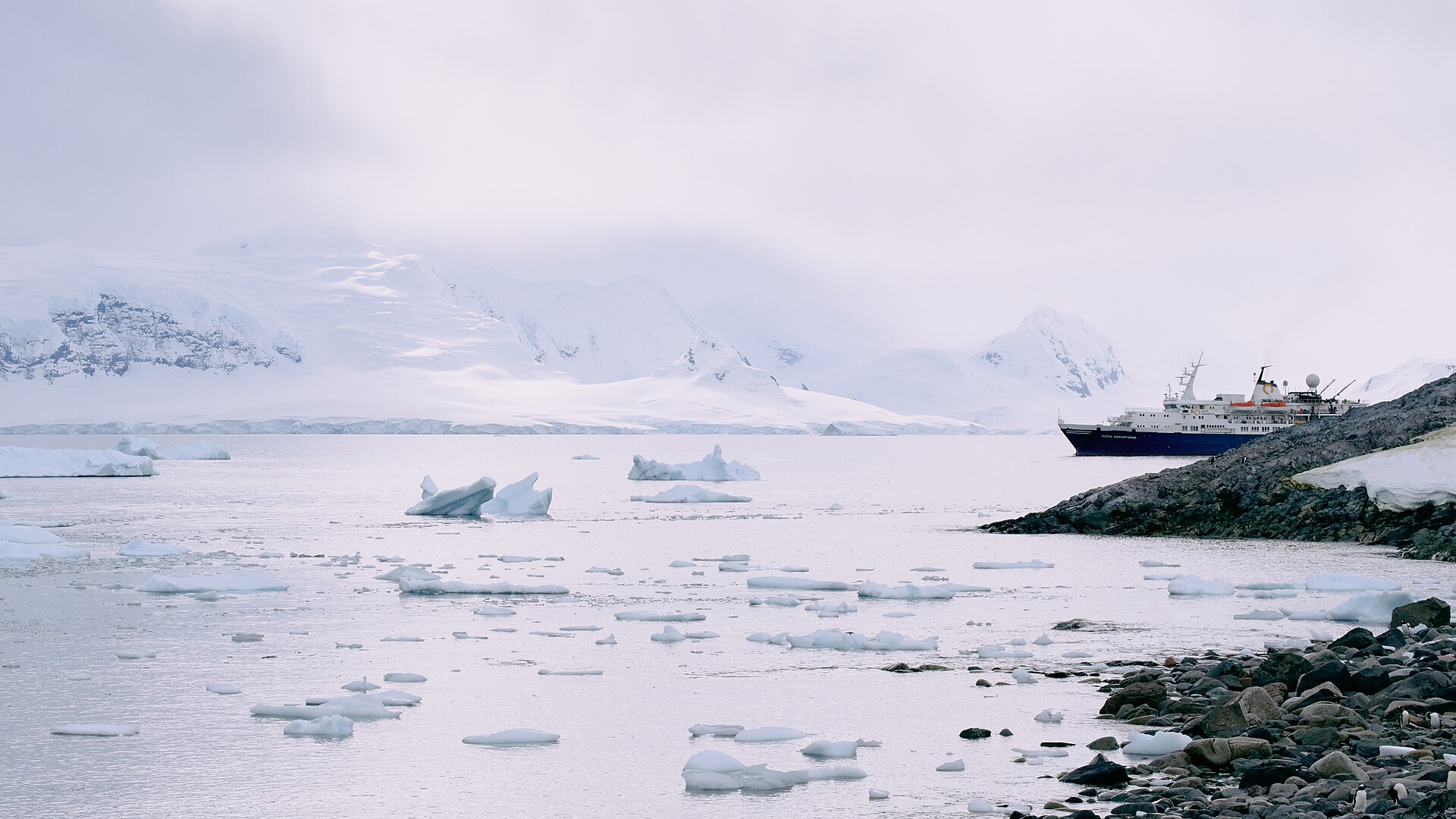
It is about 14.2 million square kilometres — larger than the United States and Mexico combined — and about 98% of it is covered in ice. It has no country, no capital, no permanent residents, no indigenous population and no army. It is the only continent with no government of its own, and it has been kept that way for over sixty years by a treaty with just fourteen articles. How does a whole continent belong to nobody — and why has nobody tried to take it?
The answer starts in 1957–58, the International Geophysical Year, when scientists from twelve nations set up research stations across Antarctica and discovered that cooperation worked better than competition. On 1 December 1959 those twelve countries — Argentina, Australia, Belgium, Chile, France, Japan, New Zealand, Norway, South Africa, the Soviet Union, the United Kingdom and the United States — signed the Antarctic Treaty in Washington. It entered into force on 23 June 1961, and it now has 58 parties. The treaty did something clever about the seven nations that claimed wedge-shaped slices of the continent: Article IV froze all claims. No claim can be expanded, no new claim can be made, and nothing done under the treaty creates sovereignty rights. Article I reserves the continent for peaceful purposes only — no military bases, no weapons testing, no military exercises. In 1991 the Madrid Protocol went further, designating Antarctica a "natural reserve, devoted to peace and science" and banning all mineral-resource activity except for scientific research. A common claim is that the mining ban "expires in 2048"; it does not. After 2048 a review conference can be called, but the ban has no end date. A fourteen-article treaty, written before the space age, is still the law of an entire continent.
Nobody lives there permanently — but plenty of people live there temporarily. Roughly seventy research stations, run by around thirty countries, host about 5,000 people in the southern summer and about 1,100 through the dark winter, when temperatures fall far below anything most humans have felt. The largest base is the United States' McMurdo Station, a small town of laboratories, dormitories and a runway, housing roughly 1,000 to 1,200 people in summer and 150 to 250 in winter. The Amundsen–Scott South Pole Station keeps only about fifty people through the winter, nine months of darkness and isolation at the bottom of the world. Everyone there is a visitor: scientists, engineers, cooks, pilots and doctors, all of them going home when their season ends. There are no citizens of Antarctica, no Antarctic passports, and no one born there who stayed.
The cold is the continent's other claim to fame. The lowest temperature ever recorded on Earth — minus 89.2°C, or minus 128.6°F — was measured at the Soviet Union's Vostok Station on 21 July 1983. At that temperature, exposed skin freezes in seconds, metal becomes brittle enough to snap, and the air itself feels like it might shatter. Vostok sits on the polar plateau, nearly 3,500 metres above sea level, in the middle of a desert of ice that receives less precipitation than the Sahara. It is the reason Antarctica has no permanent residents: no town in history has ever been built where the air itself can kill you in a minute.
And here is the fun anecdote — the one time a country tried to use a birth certificate as a territorial claim. In late 1977, Argentina airlifted a heavily pregnant woman, Silvia Morella de Palma, to its Esperanza Base on the Antarctic Peninsula, so that her child would be born on the continent. On 7 January 1978 she gave birth to Emilio Marcos Palma, a 3.4-kilogram baby boy, the first person ever born on the Antarctic mainland — an entry in the Guinness Book of Records. The birth conferred no territorial rights under the treaty, and Emilio took his parents' Argentine nationality. Since then, only eleven children in total have been born in Antarctica, all to Argentine or Chilean parents. A baby, delivered on purpose at the end of the world, to stake a claim that the treaty had already frozen: it is the most human story on a continent that has no humans of its own.
Antarctica works because nobody owns it and everybody agreed to pretend the argument is settled. The treaty froze the claims, banned the soldiers and the miners, and left the continent to the scientists — and for over sixty years, in a world that has fought over far smaller pieces of land, the arrangement has held. It is the closest thing humanity has to a working model for governing a place nobody owns. The question is whether we will remember how it was done when the next shared frontier — the Moon, the deep sea, the Arctic ocean — needs the same trick.
Related on Poptani Labs: Longyearbyen: the Arctic town where you're not allowed to die (almost), Whittier, Alaska: the town where almost everyone lives in one building, Hang Son Doong: the cave so big it has its own weather. More in this category: The World, Explained.
Sources: The Antarctic Treaty (US State Department, FRUS), Antarctica (International Polar Year), Antarctica (CIA World Factbook), How cold does it get in Antarctica? (Britannica), Emilio Palma (Wikipedia)

