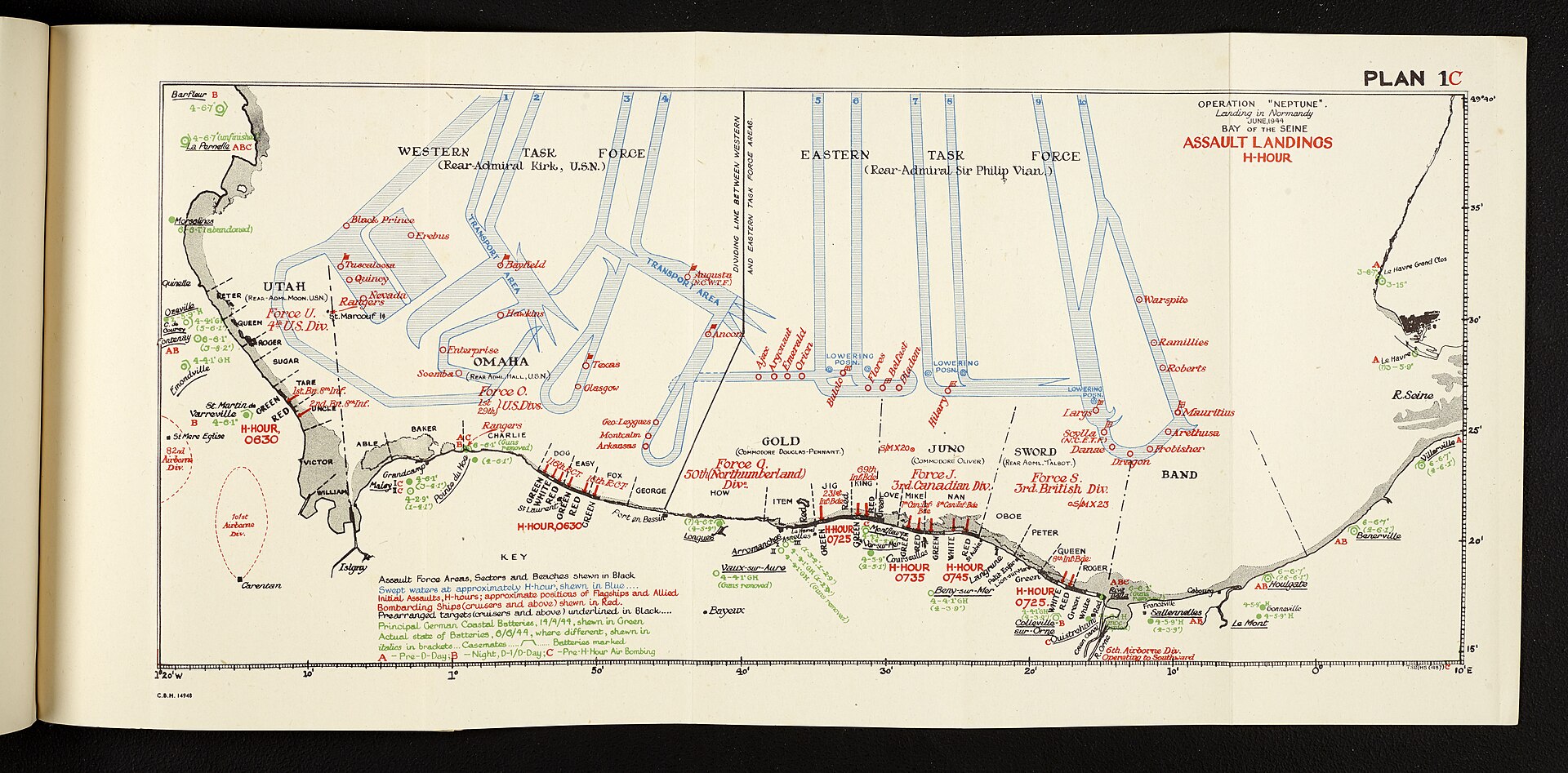
By June 1944, everything about the invasion of Normandy was planned except the one thing nobody could control: the weather. The date, 5 June, had been chosen months earlier, because the moon and the tides only aligned on 5, 6 and 7 June — a full moon for the night parachute drops, a low tide at dawn so landing craft could see the beach obstacles. Miss those three days and the next chance was two weeks away, with every day of waiting leaking the secret a little further. More than 150,000 men were loaded onto ships and waiting. The decision would come down to a forecast, made without satellites, without computer models and without weather radar. This is a research-based account, drawn from NASA's retelling and the histories of the forecasting effort — no speculation about what might have happened on another date.
The forecasting job fell to three teams: the US Army Air Corps, the British Royal Navy, and the British Meteorological Office. They did not agree. The American team, led by Colonel Irving Krick, matched the coming days against historical weather patterns and argued 5 June would be fine. The British teams, including the Norwegian meteorologist Sverre Petterssen, read the actual pressure maps and predicted a violent Atlantic storm sweeping through the Channel on 5 June, with no improvement before the next tidal window. Sitting between them was Group Captain James Martin Stagg, a Scottish geophysicist appointed chief meteorologist to the invasion force in November 1943. His job was to reconcile the teams into a single agreed forecast and present it to Eisenhower — a civilian scientist, given a military rank so that generals would listen to him. The two schools of forecasting were genuinely opposed, and Stagg had to choose.
On the evening of 4 June, Stagg walked into Southwick House, the Allied headquarters near Portsmouth, and told Eisenhower the weather was wrong and getting worse: high winds, heavy rain, low cloud that would blind the naval gunners and ground the air forces, seas rough enough to swamp landing craft. Eisenhower postponed the invasion by a day. It was the right call and a costly one — some ships were already at sea and had to turn back, and every hour of delay risked the Germans learning what was coming. And 5 June was exactly as the British team had predicted: lashing rain, high winds, seas too rough for any landing. The postponement had been justified. The question was whether there would be any day to postpone to.
Late on 4 June, Stagg found it in the data. A weather ship positioned 600 miles west of Ireland reported that barometric pressure was rising — evidence that a ridge of high pressure was building behind the storm. It would be brief and imperfect: perhaps 36 hours of workable weather, not good weather, wedged between two storms. In his assessment that evening, Stagg told Eisenhower conditions on 6 June would be workable, not ideal, but sufficient. Eisenhower asked each of his senior commanders in turn, then gave the order — "Okay, let 'er rip," he reportedly said, at an early-morning meeting on 5 June. When the first paratroopers dropped just after midnight and the first landing craft reached the beaches at dawn on 6 June, the weather was still rough: cloud cover scattered the paratroopers, and high seas made the landings brutal. But by noon the skies cleared, just as the forecast had promised. The window had held.
Here is the fun anecdote — the forecast's first warning came from a 21-year-old woman at a weather station on the far edge of Europe. Maureen Flavin Sweeney worked at Blacksod Point, a remote station on the west coast of County Mayo, Ireland. Ireland was officially neutral in the war, but its weather service quietly shared its observations with the Allies. On 3 June, at 1:00 PM, Sweeney recorded barometric pressure falling fast — among the first readings to detect the severe storm system approaching from the Atlantic. Her observation went to the Allied forecasters and fed into Stagg's decision to postpone. Across the Channel, the Germans had drawn the opposite conclusion: their forecasters predicted gales persisting until mid-June, and were so confident no invasion could come that they let soldiers leave the beaches for war games in Rennes — and Field Marshal Erwin Rommel, responsible for defending the coast, left Normandy to visit his wife in Germany for her birthday. The Allies were forecasting with the enemy's weather as well as their own; the Germans were forecasting blind.
D-Day is remembered as a triumph of planning, ships and courage — and all of that is true. But the date itself was decided by a barometer reading from a ship 600 miles off Ireland, a falling-pressure report from a 21-year-old at a remote Irish weather station, and a scientist willing to tell the most powerful commanders on earth that they had to wait. A 36-hour gap between two storms was all the largest invasion in history needed — and all it got.
Related on Poptani Labs: The wrong turn that started a world war: Sarajevo, 28 June 1914, The man who didn't press the button: Stanislav Petrov, 26 September 1983, The missing hyphen that blew up a rocket to Venus. More in this category: The Butterfly Effect.
Sources: Forecasting D-Day (NASA Science), Weather forecasting for Operation Overlord (Wikipedia), The Weather Forecast That Decided D-Day

