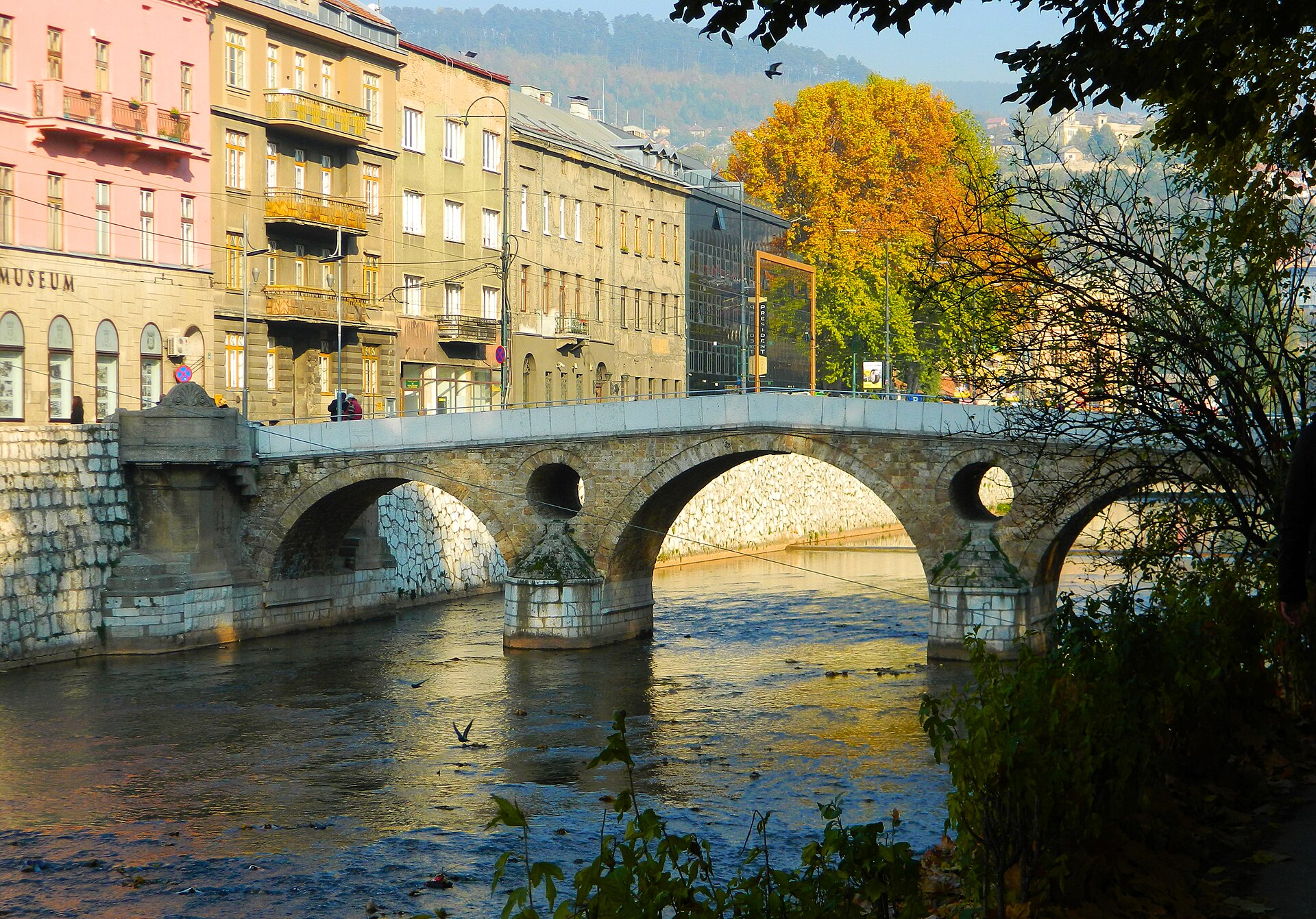
On the morning of Sunday 28 June 1914, a motorcade drove through Sarajevo carrying the heir to the Austro-Hungarian throne, Archduke Franz Ferdinand, and his wife Sophie, Duchess of Hohenberg. By lunchtime both were dead, shot at point-blank range on a street corner. Within five weeks, Europe was at war. And the whole thing turned on a wrong turn — a driver who had not been told the route had changed.
This is a research-based retelling, drawn from the sources below. The facts are not in dispute; historians still argue about how much weight one accident can carry.
The archduke's visit was no secret. The motorcade's route along the Appel Quay, the wide avenue beside the River Miljacka, had been published in advance — which meant the assassins knew exactly where to stand. Six young conspirators from the Bosnian nationalist group Mlada Bosna, armed with pistols, grenades and cyanide capsules supplied through the Serbian Black Hand network, took up positions along the road.
The first to act was Nedeljko Čabrinović. As the open car passed, he hurled a grenade at it. The driver saw the object in the air and accelerated; the grenade glanced off the folded convertible roof, bounced into the street and exploded under the following car, wounding around twenty people. Čabrinović swallowed his cyanide capsule and leapt into the Miljacka — but the poison was stale and the river shallow, so he was hauled out alive. The motorcade sped on to the Town Hall, the remaining conspirators unable to act as the cars raced past at speed.
At the Town Hall, Franz Ferdinand did something stubborn and, in hindsight, fateful: he insisted on visiting the wounded from the bombing at the hospital. To get there safely, the governor, General Oskar Potiorek, changed the route — the cars would stay on the Appel Quay all the way, instead of turning off into the old town as originally planned.
Somewhere in the chain of officials, that change never reached the driver — Leopold Lojka, in most accounts. Following the original instructions, he turned right off the Appel Quay and onto Franz Josef Street. Potiorek, riding in the car, realised the error and shouted that this was the wrong way. The driver braked and began to reverse the car back toward the quay. The car stalled — directly in front of Moritz Schiller's delicatessen, on the corner by the Latin Bridge.
Standing at that exact corner was Gavrilo Princip, nineteen years old, who had already concluded his own chance was gone for the day. After the failed bombing he had drifted away from his post and ended up by Schiller's shop, a loaded pistol still in his coat, with no plan left. History, it seemed, had moved on without him.
Then the car stopped five feet away, with no crowd between them. Princip stepped forward, drew his FN Model 1910 pistol and fired twice. The first bullet struck Sophie in the abdomen; the second hit Franz Ferdinand in the neck, severing his jugular vein. Both were still alive when the car sped away to the governor's residence, but both died within the hour.
You may have heard Princip had just bought a sandwich at Schiller's. It is a popular flourish with no contemporary evidence — the sources agree only that he happened to be standing at that corner.
The morning's strangest detail is how thoroughly the assassins' own plans failed — and how little it mattered. Čabrinović's cyanide was too old to kill him, and the river he jumped into was barely ankle-deep, so the first attacker of the day was fished out and arrested within minutes. Princip, too, swallowed poison from the same batch after the shooting; it made him violently ill but did not kill him, and bystanders overpowered him before he could turn the gun on himself. He was tried as a minor and sentenced to twenty years in prison.
Everything the conspirators had prepared went wrong. The bomb missed, the poison failed, the getaway was hopeless. And yet a missed message to a driver delivered the target to the one man who still had a loaded gun — at a range of about five feet.
The assassination set off the July Crisis: Austria-Hungary issued an ultimatum to Serbia, Russia mobilised in Serbia's defence, Germany declared war on Russia and France, and Britain entered days later. Within five weeks of that wrong turn, the great powers of Europe were at war — a war that would last four years, kill millions, and topple four empires.
That is the honest limit of the story, though. The wrong turn was the trigger, not the cause. Europe in 1914 was already primed: rival alliance blocs, an arms race, Balkan tensions, and leaders who believed a short war was winnable. A hundred other sparks might have lit the same powder. What makes Sarajevo unforgettable is not that a wrong turn caused a world war — it is that, on a morning when every part of the plot had failed, one uncommunicated route change put the heir to an empire within arm's reach of the one assassin who had given up.
Small causes do not need to be sufficient causes to change the world — they only need to arrive at the exact moment the system is ready to tip. Sarajevo is the clearest example on record: a driver's missed instruction, a stalled car, a nineteen-year-old who had already given up. The war that followed had deeper roots, but the spark was a wrong turn on a Sunday morning. The practical lesson is about the unglamorous kind of failure — the message that never reaches the person who needs it. Most days, a missed instruction costs nothing. On 28 June 1914, it cost everything.
Related on Poptani Labs: The press conference that accidentally toppled the Berlin Wall, The butterfly ballot: how a confusing ballot design decided a presidency, The 2010 Flash Crash: how $1 trillion vanished in 36 minutes. More in this category: The Butterfly Effect.
Sources: Cambridge University Library — Sarajevo 1914, EBSCO Research Starters — Gavrilo Princip, UNCG — Sarajevo, June 28, 1914 (Micheal Shackelford), History Collection — Gavrilo Princip Gave Up: Then Franz Ferdinand's Car Stalled Before Him

