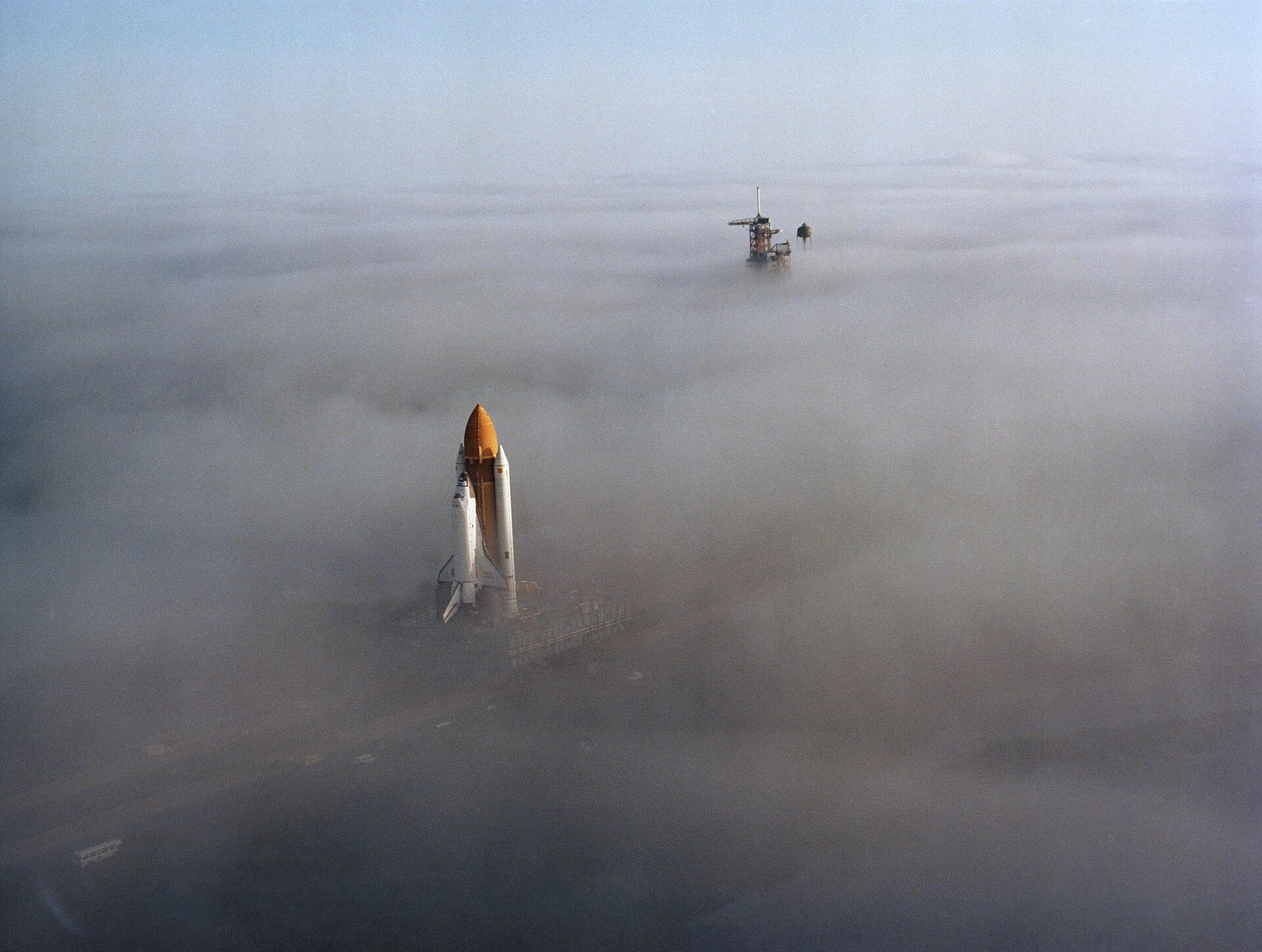
On January 28, 1986, the space shuttle Challenger broke apart 73 seconds after launch, killing all seven people aboard — including Christa McAuliffe, the teacher who was meant to give a lesson from orbit — as millions watched on television. President Reagan appointed a commission to find out why. Among its members was Richard Feynman, the Nobel Prize-winning physicist from Caltech, a man famous for explaining hard things simply. Two weeks later, in front of the cameras, he explained the disaster with a glass of ice water.
Feynman won the Nobel Prize in Physics in 1965 for his work on quantum electrodynamics — the theory of how light and matter interact — and he was one of the great teachers of the subject: his Feynman Lectures on Physics are still read by students today. He had worked on the atomic bomb at Los Alamos as a young man, picked locks for fun, played the bongo drums, and wrote bestselling books about the pleasure of figuring things out. He liked to say that he had learned to think by taking things apart — radios as a boy, and, later, the assumptions of the people around him. He was invited onto the Rogers Commission by NASA's acting director, William Graham — his former student at Caltech. He arrived determined to ignore the ceremony and talk to the engineers.
The night before the demonstration, Feynman was at dinner after a closed session of the commission. He noticed a glass of ice water on the table — and realised he could test the suspect material himself. He had a sample of the rubber used in the shuttle's O-ring seals, the rings that sealed the joints of the solid rocket boosters. He pressed a piece into a small clamp, left it standing in the ice water, and waited.
At the public hearing on February 11, 1986, Feynman lifted the clamp from the glass and pulled the rubber free. It stayed compressed. It did not spring back. "I believe that has some significance for our problem," he said. The point was simple enough for anyone watching to grasp: the rubber lost its resilience in the cold, and Challenger had launched on the coldest morning of any shuttle flight — 36 degrees Fahrenheit at the pad, 15 degrees colder than any previous launch. A seal that cannot spring back cannot close the gap it is meant to seal, and hot gas had leaked through the joint. The engineers who built the boosters had warned NASA the night before the launch; the warning had been overruled.
Feynman did not stop at the demonstration. Digging into the numbers, he found that NASA's management believed the chance of a shuttle failure was one in a hundred thousand — while the engineers who built the thing estimated one in a hundred. He wrote his findings into an appendix to the commission's report. When the chairman wanted the appendix softened, Feynman threatened to take his name off the report unless it was printed as written. It was. Appendix F ends with a sentence that has become a maxim of engineering ethics: "For a successful technology, reality must take precedence over public relations, for Nature cannot be fooled."
Feynman's glass of ice water is remembered as a great television moment, but it was something rarer: an experiment, done in public, that answered a question nobody in power wanted asked. The lesson he left in Appendix F was not about rubber. It was about the gap between what managers believe and what engineers know — and what happens when nobody is willing to close it.
Related on Poptani Labs: Carl Sagan and the pale blue dot: the photo that shrank the world, Stoicism, explained: the 2,300-year-old philosophy for stormy times, Did a mushroom make us human? Terence McKenna's "stoned ape" idea. More in this category: Big Thinkers.
Sources: Nautilus, how Richard Feynman found the root of the Challenger disaster, Terribly Interesting, Feynman's ice water test and the Challenger O-rings

