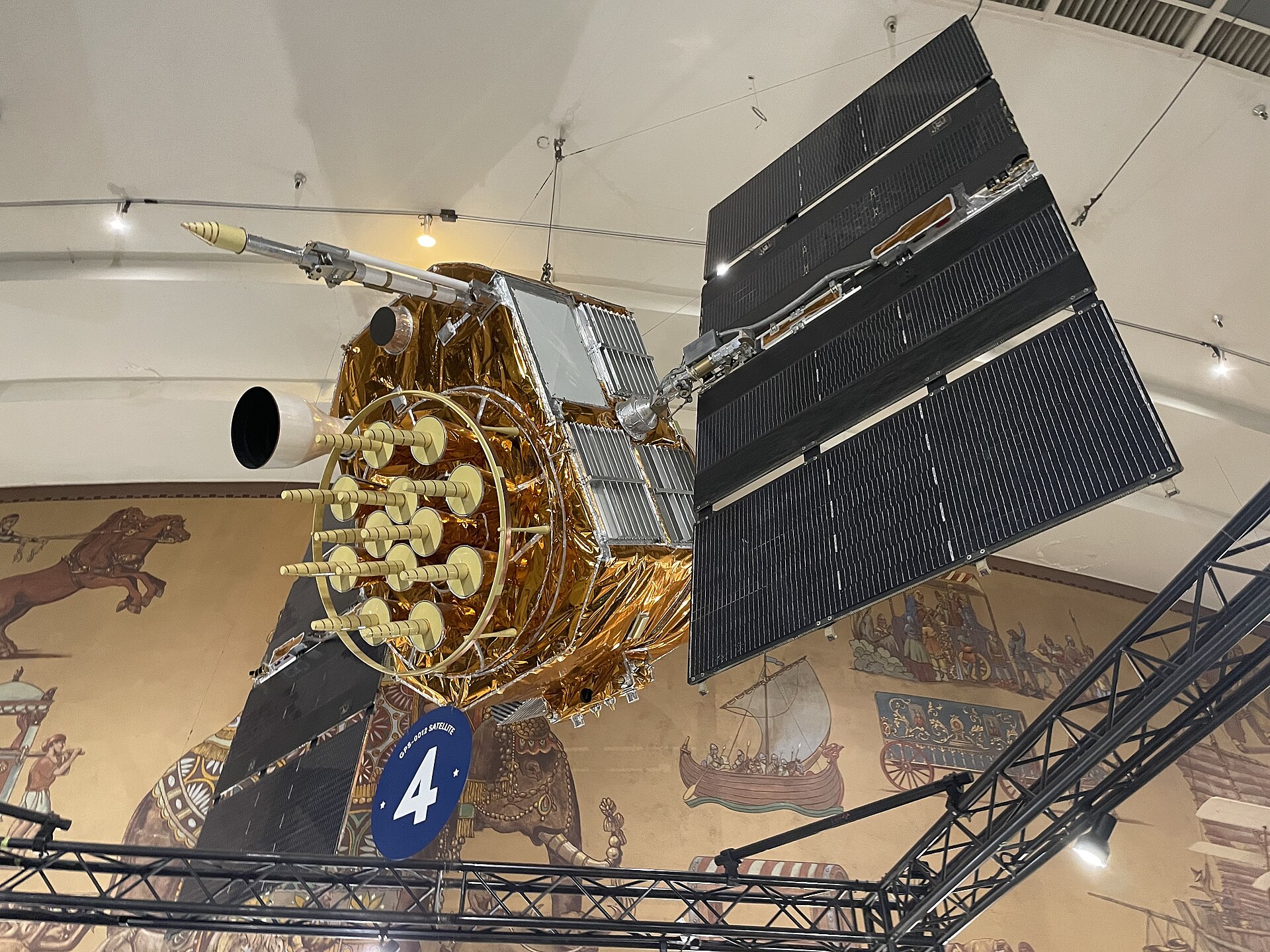
Ask your phone where you are and it answers within a few metres — using nothing but radio signals from satellites about 20,200 kilometres overhead, each carrying an atomic clock. The strange part: the system only works because Einstein was right, and the clocks in space are deliberately set to run wrong. This is a research-based explainer — no hands-on testing, just how the system works and how it got here.
There are 31 operational GPS satellites up there right now, each circling the Earth twice a day. Every one carries an atomic clock accurate to about a billionth of a second, and every one is doing nothing but broadcasting the same two things, over and over: here is exactly what time it is, and here is exactly where I am. Your phone's receiver measures how long each signal took to arrive and multiplies by the speed of light to get a distance. One satellite puts you somewhere on a sphere. Three narrow it down to two possible points. The fourth is the clever part: it lets the receiver solve for its own clock error as a fourth unknown, alongside the three coordinates — because your phone's clock is cheap and inaccurate, and the system needs to correct for that too. This process is called trilateration, and it is the core of how GPS actually locates you. The GPS project was started by the US Department of Defense in 1973, the prototype spacecraft was launched in 1978, and the full constellation of 24 satellites became operational in 1993. Its three official inventors are Roger Easton, who developed the TIMATION system and solved the problem of keeping satellite clocks accurate with the first space-qualified atomic clocks; Ivan Getting, who conceived a real-time, three-dimensional positioning system; and Bradford Parkinson, often called the architect of modern GPS.
Here is the detail that turns GPS from a useful gadget into something truly strange: for the system to work at all, it has to correct for Einstein's theories of relativity, actively, every single day. GPS satellites orbit at roughly 14,000 kilometres per hour. According to special relativity, a clock moving that fast runs slightly slow relative to a stationary observer — the satellite clocks lose about 7 microseconds a day from this effect alone. But the satellites are also sitting much higher up than the surface of the Earth, in a meaningfully weaker gravitational field, and general relativity says a clock in weaker gravity runs fast relative to one closer to Earth's mass — by about 45 microseconds a day. These two effects don't cancel out. General relativity wins, by a wide margin, leaving GPS satellite clocks running a net 38 microseconds faster per day than an identical clock on the ground. Left uncorrected, that daily drift would translate into GPS positions wandering off by roughly 10 kilometres every single day. So the engineers built the correction directly into the satellites: each atomic clock is manufactured to run at a very slightly different frequency than a ground clock would — 10.22999999543 MHz instead of 10.23 MHz — specifically pre-tuned so that once it is in orbit and relativity does what relativity does, the result comes out correct. GPS is, quietly, one of the largest-scale practical confirmations of general relativity ever built.
For its first two decades, GPS was primarily a military system. Then, on September 1, 1983, Korean Air Lines Flight 007 — a Boeing 747 carrying 269 people — strayed into Soviet airspace because of navigational errors and was shot down by Soviet interceptors. All 269 people on board were killed. Two weeks later, President Ronald Reagan announced that GPS would be made available for civilian use once completed. A navigation system built for nuclear submarines and stealth bombers had its future secured because a civilian plane got lost. Even then, the Pentagon deliberately degraded the civil signal through a programme called Selective Availability, introducing random errors that limited accuracy to about 100 metres. It wasn't until May 2000 that President Bill Clinton ordered it switched off — and overnight, accuracy jumped from 100 metres to about 10.
Here is the fun part: the GPS signal that reaches your phone is absurdly weak — roughly 10-16 watts, about a billion billion times weaker than a light bulb. Your phone picks it out of the noise because it knows exactly what pattern to listen for, a trick that traces back to the system's military origins. And the system keeps time as well as it keeps place: the same atomic clocks that tell your phone where you are also keep the world's financial networks, power grids, and mobile phone towers synchronised. Every time your map loads, you are using a Cold War weapons programme, corrected for Einstein, that only became yours because of a tragedy in 1983.
A GPS receiver is a clock that listens to other clocks. The satellites tell it the time, relativity tells it how to correct the time, and four distances tell it where you are. It works because a handful of engineers in the 1970s believed Einstein over their own intuition — and because a president in 1983 decided that a navigation system should belong to everyone. Your phone knows where you are because the sky is full of clocks.
Related on Poptani Labs: How a microwave oven actually heats your food (and why metal sparks), LEGO bricks: the tiny tolerance behind a plastic toy, The barcode: the lines drawn in sand that changed shopping forever. More in this category: Built in the Lab.
Sources: On Further Reflection, From Sputnik to Einstein: The Everyday Wonder of GPS, HozSpace, The Invisible Constellation: How GPS Actually Works, Free AstroScience, How GPS Works: Four Satellites and a Cheap Clock, Wikipedia, Global Positioning System

