India stretches nearly 3,000 kilometres from east to west — wide enough, by the usual rules, for two time zones. Yet the whole country, from Gujarat to Arunachal Pradesh and out to the Andaman and Nicobar Islands, runs on a single clock: Indian Standard Time, UTC+5:30, all year, with no daylight saving. The result is a daily oddity. In June, the sun rises around 4 AM in Arunachal Pradesh and after 6 AM in Gujarat. Same clock time, two hours of different daylight. How did one of the widest countries on Earth end up with one time zone — and why does it keep it?
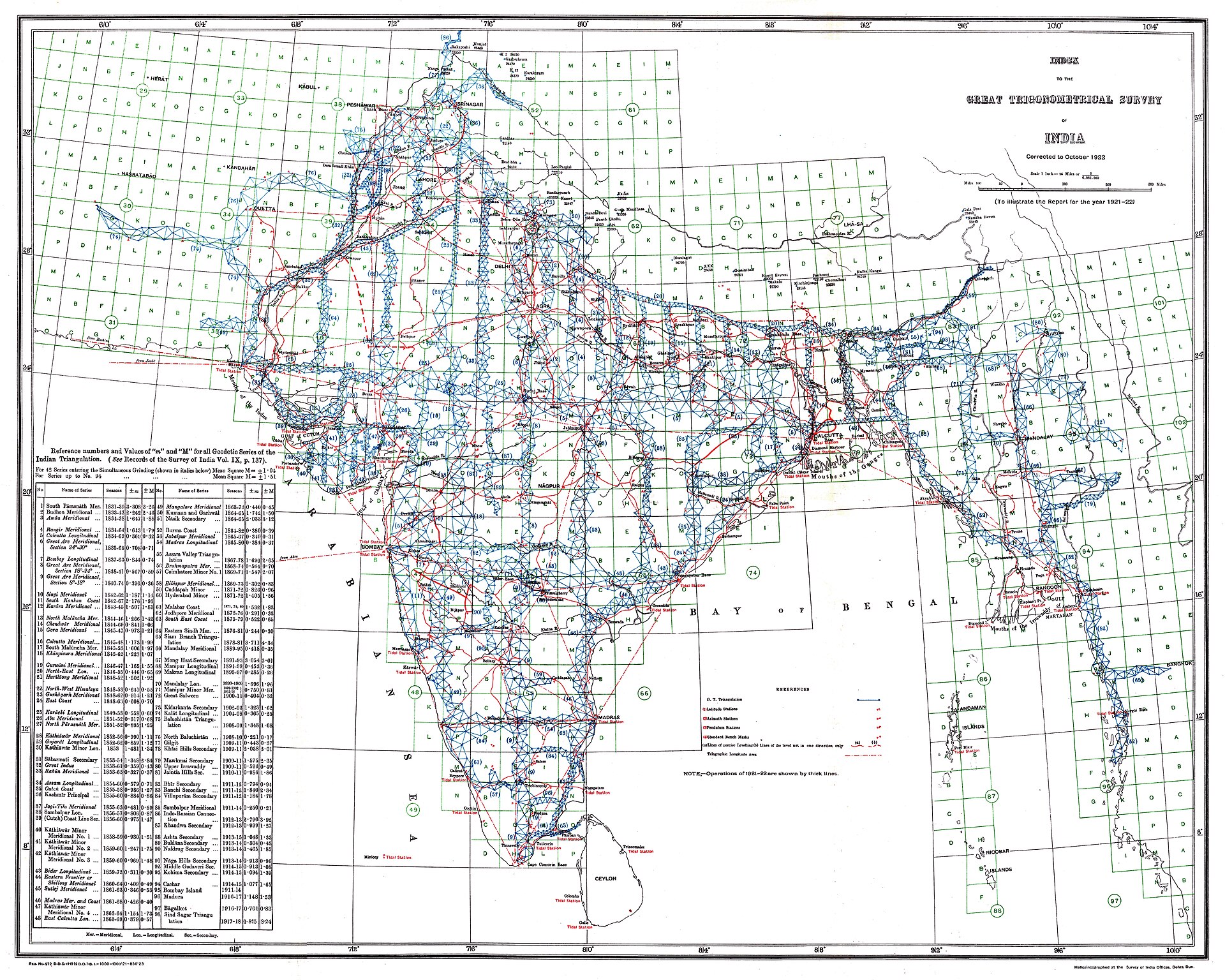
Time zones are based on the Earth turning 15 degrees of longitude every hour. India's standard meridian is 82°30′ East, a line that passes close to Mirzapur in Uttar Pradesh, roughly through the middle of the country. Divide 82.5 by 15 and you get 5.5 — hence the half hour: UTC+5:30. The choice was made by the colonial government in 1905, and Indian Standard Time came into force on January 1, 1906, replacing a patchwork of local times. Before standardisation, the big cities kept their own solar time: Bombay ran at UTC+4:51, Calcutta at UTC+5:53, and Madras at UTC+5:21. Even after 1906, the old times lingered — Calcutta kept its own time until 1948, and Bombay until 1955. The half-hour offset is a compromise by design: UTC+5 would leave the east far behind the sun, UTC+6 would leave the west far ahead of it, and 5:30 splits the difference. It is, in a sense, the whole country's timezone averaged into one number.
India spans about 29 degrees of longitude, from roughly 68°E in Gujarat to 97°E in Arunachal Pradesh — almost two hours of difference in where the sun is. With one clock for everyone, that difference shows up in sunrise and sunset. On June 21, the sun rises around 4:05 AM in Dong, Arunachal Pradesh, and around 6:10 AM in Dwarka, Gujarat. In December it sets around 4:10 PM in the east while the west still has daylight until after 6 PM. In the Northeast, it is fully light by 5 AM in summer and dark soon after 4 PM in winter — while offices, schools and railways keep hours set for the rest of the country. Critics argue this wastes daylight and electricity, and that it affects sleep: children in the Northeast walk to school in darkness in winter, and workers lose usable evening light in summer. The cost is real, and it falls unevenly on one corner of the country.
Assam's tea gardens solved the problem a century ago by simply ignoring the official clock. The gardens have long set their clocks an hour ahead of IST — an informal arrangement known as chai bagan (tea garden) time — so that work starts with the early daylight instead of in the dark. It is unofficial, local, and it works: the gardens run on garden time, the rest of Assam runs on IST, and everyone involved knows which clock applies where. It is the fun anecdote at the heart of this story, because it shows the debate in miniature. The gardens didn't petition for a second time zone. They just moved their own clocks and got on with the harvest. A country can have one official time zone and a thousand unofficial ones, and the tea gardens are proof.
The case for splitting India has been made repeatedly, most rigorously in a 2018 study by scientists at CSIR-NPL — the laboratory that actually maintains official Indian time. They proposed two zones: IST-I at UTC+5:30 for most of the country and IST-II at UTC+6:30 for the north-eastern states and the Andaman and Nicobar Islands, with the boundary drawn near 89°52′ E. Their argument was economic as much as social: aligning working hours with daylight in the Northeast would cut evening lighting demand, and they put the saving at roughly 20 million kilowatt-hours a year. An earlier study by the National Institute of Advanced Studies in Bengaluru made a different proposal — advance IST by 30 minutes across the whole country, to UTC+6:00 — and estimated it would save around ₹1,400 crore worth of electricity a year. The government rejected the two-zone idea. Its reasoning was partly practical — the risk of railway signalling errors and scheduling mistakes at a zone boundary crossed by dense traffic — and partly symbolic, since a single national clock is treated as an instrument of unity.
India is not alone in choosing unity over solar accuracy. China spans five geographical time zones and runs on one — Beijing Time — for the same reason: a single clock as a statement that the country is one. For India, the argument has held since independence, and as of 2026 the country remains on a single time zone while the debate continues. The practical case for two zones is strong, and the scientists who keep the time agree it would save energy. But a time zone is not only a technical choice. It is also a political one — about what a country wants its clocks to say. India's clocks say one country, one time. The tea gardens, meanwhile, say something else: that when the clock and the sun disagree, people will quietly follow the sun.
A clock is infrastructure and identity at the same time. India chose one time zone for a country two hours wide, and the choice has held for 120 years — through independence, through the computer age, through every study that says it costs electricity. The tea gardens keep their own time anyway, which may be the most Indian solution of all: one official answer, and a practical one beside it.
Related on Poptani Labs: The navy with no sea: why landlocked Bolivia still has sailors, Ever Given: the six days one ship stopped world trade, The canal that runs on rain: how drought squeezed world trade. More in this category: The World, Explained.
Sources: TimezoneConverter, Why India Has One Time Zone: IST, UTC+5:30 and the Two-Zone Debate, GlobalCityTime, Time Zones in India Explained, QuickTZone, Why India Has a Half-Hour Timezone: IST (GMT+5:30) Explained, Zerodha Varsity, The curious case of Indian Standard Time

