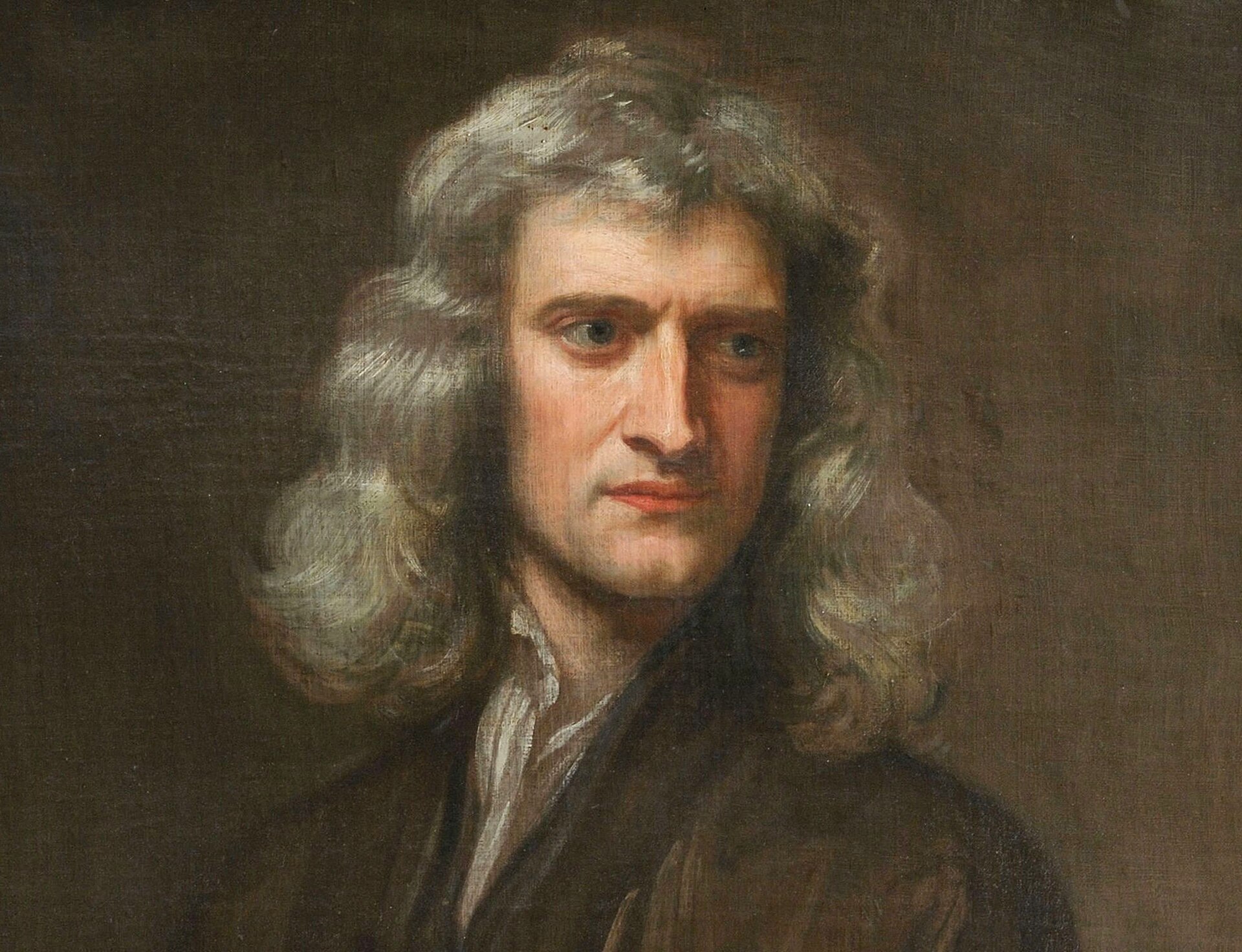
In the summer of 1665, the Great Plague reached Cambridge, and the university sent its students home. Among them was Isaac Newton, twenty-two years old, one year into serious reading in mathematics, carrying his books and his notebooks back to the stone farmhouse at Woolsthorpe in Lincolnshire where he had been born on Christmas Day 1642. He stayed about eighteen months — summer 1665 to March 1667, with only a brief return to Cambridge in the spring of 1666 before the disease drove him back. There were no lectures, no disputations, no fellows to argue with. In that enforced solitude, working mostly alone, he laid the foundations of three sciences. Later generations called it his annus mirabilis — his year of wonders. This is a research-based account, drawn from his surviving papers and the histories built on them — not a dramatisation, and the famous apple story is told here the way Newton himself told it.
The first breakthrough was in mathematics. Reading and re-reading John Wallis's Arithmetica Infinitorum, Newton generalised the binomial expansion to fractional and negative exponents, and by the autumn of 1666 he had set down the basic rules of differentiation and integration — the method he called fluxions, which the rest of the world would call calculus. The second was in optics. He bought a prism at Stourbridge Fair, shut himself in a darkened room, and let a single thread of sunlight through a pinhole fall onto the prism — and watched white light come apart on the wall into a band of colours. He showed that white light is made of all the colours of the spectrum, and he gave the colours their names. The third was gravity. Watching an apple fall in the garden at Woolsthorpe, he wondered whether the force pulling it to the ground might extend as far as the Moon — and by degrees, as his later biographer put it, he began to apply that property of gravitation to the motion of the Earth and the heavenly bodies. None of it was published for years. The calculus waited decades; the optics waited until 1704; gravity waited for the Principia in 1687, twenty years after the plague year. But the work was done in those eighteen months, by a young man with no laboratory, no colleagues, and no audience but himself.
Here is the fun anecdote — and the correction that comes with it. The apple did not hit Newton on the head. There is no reliable evidence for that, and Newton never claimed it. The story comes from Newton himself, told in old age: in 1726, sitting under apple trees in his London garden, he told his friend William Stukeley that the idea of gravitation had come to him decades earlier, while sitting in a contemplative mood at Woolsthorpe and observing an apple fall perpendicularly to the ground. Stukeley published the account in 1752, in his Memoirs of Sir Isaac Newton's Life. The apple fell beside him; what mattered was the question it raised. If all matter has drawing power, Newton reasoned, then the Earth draws the apple — but the apple also draws the Earth, in proportion to its quantity. And if the force extends to the Moon, it extends throughout the universe. A descendant of the original tree still stands in the garden at Woolsthorpe, now run by the National Trust — a living footnote to the most famous anecdote in science, and one of its most embellished: the Royal Society itself calls the story one of the most famous, and most embroidered, in the history of science.
Newton's plague-year work had a cost, and it was his eyesight. He was not a cautious experimenter. His optical experiments turned, at one point, onto his own eyes: he stared into bright light to study how vision worked, and the experiments on his own eyes brought him close to blindness. It is the least romantic detail of the year of wonders — a brilliant young man, alone in a farmhouse, risking the one instrument his work depended on. He recovered, and went on to build the first working reflecting telescope in 1668, to win the Lucasian chair of mathematics at Cambridge in 1669 at the age of twenty-six, and to publish the Principia in 1687, setting out the three laws of motion and the law of universal gravitation. In a letter to Robert Hooke in 1676, he wrote the line that has outlived all of it: "If I have seen further than others, it is by standing on the shoulders of giants." The giants were real — Galileo, Kepler, Descartes — and Newton knew it. But the eighteen months at Woolsthorpe were his alone, and nothing in science has quite matched them since.
Newton's plague year is the idea to remember because it breaks the story we tell about genius. There was no flash of lightning, no apple to the head, no sudden revelation — just a young man, sent home by a plague, with books, a prism, and eighteen months of nothing to do but think. The calculus, the spectrum, and gravity all came out of that quiet. The lesson is not that isolation makes geniuses; it is that deep work needs uninterrupted time, and that a closed university can be the beginning of a career rather than the end of one. He went home because he had to. He came back having changed what science could do.
Related on Poptani Labs: Ada Lovelace: the woman who wrote the first program for a computer that didn't exist, Daniel Kahneman and the two systems that run your mind, Feynman's glass of ice water: the 30-second demo that explained a disaster. More in this category: Big Thinkers.
Sources: Isaac Newton's remarkable year — and the plagiarism accusations that followed (Nature), Isaac Newton: life, discoveries and places of the father of modern physics (Regno Unito), Isaac Newton: Woolsthorpe, the plague years, Principia, the Mint, the apple myth (Orbisica)

