India is big enough to hold several landscapes that look like they belong somewhere else entirely: a bridge that was never built, a national park with no solid ground, a lake that changed colour overnight, and a road where cars seem to roll uphill. None of them needs exaggeration. The real explanations are stranger than the myths.
In the rain-soaked hills of Meghalaya, the Khasi and Jaintia people do not build footbridges over flooded streams. They grow them. The aerial roots of the rubber fig tree (Ficus elastica) are guided across the water, sometimes through hollow bamboo or betel-nut trunks used as scaffolding, until they knit together into a walkable span. A bridge takes roughly 10 to 15 years of patient training before it can be used — and unlike a concrete bridge, it keeps growing stronger as its roots thicken.
The most famous is the double-decker bridge at Nongriat, near Sohra (Cherrapunji): two tiers of roots stacked over the Umshiang stream, reached by a descent of around 3,500 stone steps from Tyrna village. The bridges, known as jingkieng jri, were added to UNESCO's tentative World Heritage list in March 2022 — a first step toward possible inscription, not the status itself — covering around 100 known bridges across 72 villages.
Sources: Smithsonian Magazine, Hill Rovers
Loktak, the largest freshwater lake in northeast India, is covered in phumdis — thick floating mats of vegetation, soil and decomposing organic matter, only about a fifth of which sits above the waterline. The largest single phumdi, roughly 40 square kilometres in the lake's southeastern corner, is dense and stable enough to walk on. It is, improbably, a national park: Keibul Lamjao, declared in 1977, is the world's only floating national park.
It is also the last natural home of the sangai, Manipur's brow-antlered deer, whose entire wild population — around 260 animals — lives on these floating meadows. The system is fragile: the Ithai Barrage, built in 1983, keeps water levels high for longer, which stops the phumdis from grounding seasonally and regenerating. Fishermen still build huts called phumsangs on smaller phumdis, living on ground that moves with the water.
Sources: Outlook Traveller, Times Life
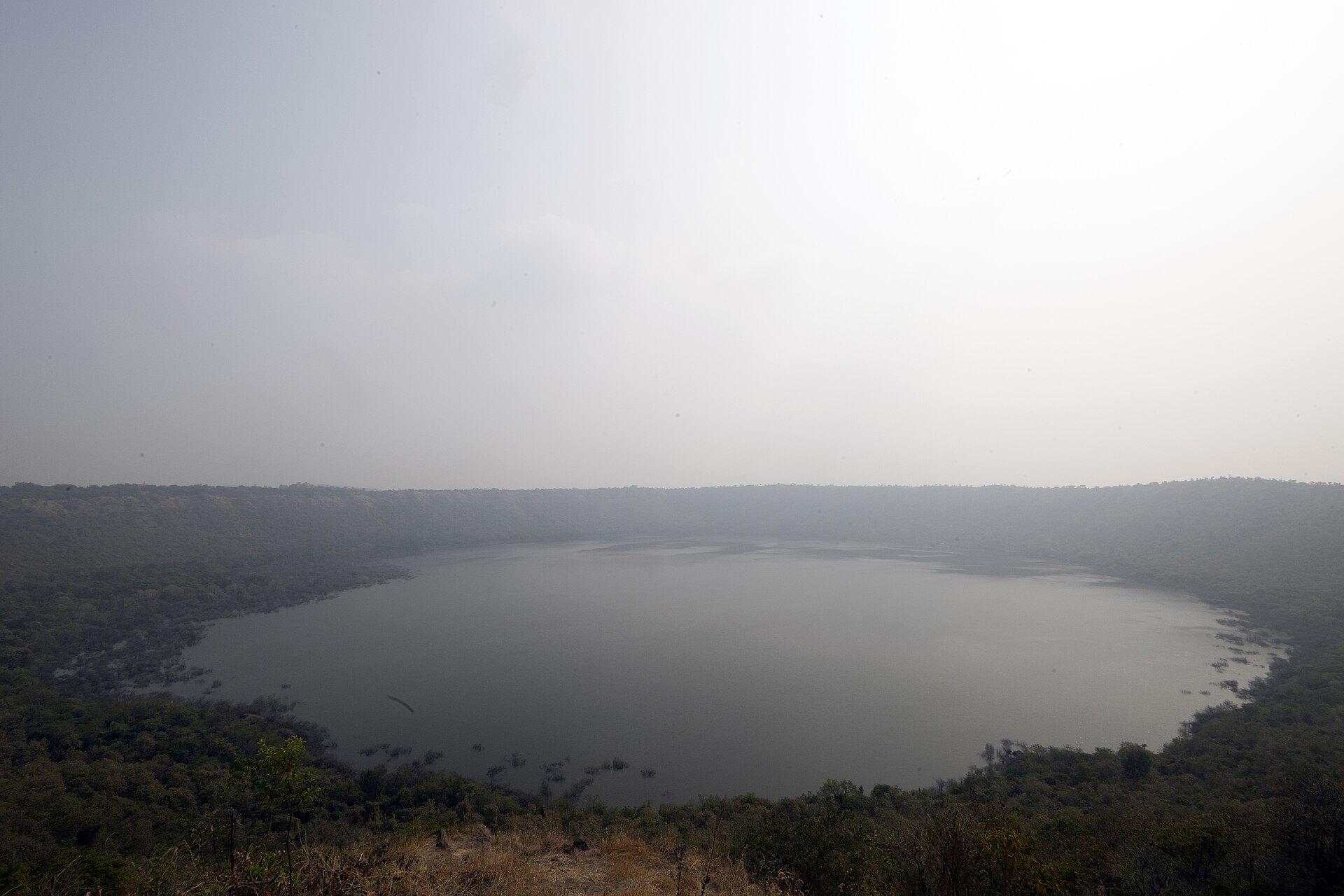
Lonar Lake sits in a circular crater about 1.8 kilometres wide and 150 metres deep, carved into the Deccan basalt of Buldhana district by a meteorite impact tens of thousands of years ago. It is one of very few impact craters in basalt anywhere on Earth, which is why scientists study it as an analogue for craters on the Moon and Mars. The lake has no outlet, so minerals accumulate: its water is both saline and alkaline, with a pH around 10.5, hostile to most life. For a long time it was thought to be volcanic; the discovery of maskelynite — a glass that forms only under extreme impact pressure — settled the meteorite question in the 1970s.
Here is the part that still delights me. In June 2020, the lake's usual green water turned vivid pink over a few days, bright enough to show in satellite images. Researchers from Pune's Agharkar Research Institute and the National Environmental Engineering Research Institute traced it to a bloom of haloarchaea, salt-loving microbes that produce a pink pigment. Low rainfall and high temperatures had raised the lake's salinity and created ideal conditions for the bloom. When the monsoon arrived and diluted the water, the green algae returned and Lonar went back to its normal colour — a reminder that the strangest sight at Lonar was not the crater, but the life inside it.
Sources: The Times of India, NASA Earth Observatory
About 30 kilometres from Leh, on the Leh–Kargil highway, a marked stretch of road has a reputation for pulling vehicles uphill with their engines off. The popular story credits a powerful magnetic field in the rocks. It has been tested directly: magnetometer readings at the site came back at ordinary background levels of 25 to 60 microtesla, far too weak to move a car, and the Indian Air Force has confirmed no magnetic disturbance affects the stretch.
The real explanation is a gravity hill, an optical illusion. The surrounding ridges block the true horizon, so the brain misreads a gentle downhill slope as an uphill climb. The car is simply rolling downhill while your eyes insist otherwise. It is a neat demonstration of how much our sense of slope depends on a visible horizon — remove the reference, and the world tilts.
Sources: Ladakh Life, Discover With Dheeraj
Lonar's basalt is so similar to the rock of the Moon that researchers have studied the crater as a stand-in for lunar and Martian landscapes — meaning one of the most alien-looking places in India is also, scientifically, the closest thing to walking on another world without leaving Earth. And the root bridges offer the opposite lesson: the things that take the longest to grow tend to be the ones that last.
More from Around the World: how Mexico sets an extra place at the table for Día de Muertos, the 2,700 witch hats counted by drone in Salem, and the 2,856-lb pumpkin named Bagheera.

