Eight hundred and fifty kilometres north of Adelaide, in the red heart of South Australia, there is a town that is mostly invisible. From the road, Coober Pedy looks like a scattering of low buildings, ventilation pipes, and mounds of dug earth. Half of its people are not on the surface at all. They live underground, in homes carved into the sandstone — cool, quiet, and windowless — in a town built around one of the world's strangest industries. This is the largest underground mining town on Earth, and it exists because of a boy who went looking for water.
In 1915, a 14-year-old named Willie Hutchison was out prospecting with his father, who was searching for water in the dry country. Willie found something else: opal, the gemstone that flashes with rainbow colour. The discovery set off a rush, and the settlement that grew around the diggings was officially named Coober Pedy in 1920 — from the Aboriginal words kupa piti, often translated as "white man's hole in the ground". The town became the world's opal capital, and it remains the source of most of the world's opals.
The reason for going underground is simple: heat. Summer days on the surface regularly pass 40°C, and the rock below stays at a steady 23°C all year, with no air conditioning at all. Around half of the town's roughly 2,000 residents live in dugouts — homes carved into the hillsides, with living rooms, kitchens, and bedrooms, wired for electricity and lit warmly despite having no windows. Adding a room is a matter of digging another one. The town's churches are underground too — including the Serbian Orthodox Church and the Catholic Church of St Peter and Paul — along with an underground hotel, an underground bar, and a bookshop in a converted mine shaft.
Coober Pedy's golf course has no grass at all. The fairways are red dirt and sand, and players carry a small patch of artificial turf to tee off from. Because the daytime heat makes afternoon rounds unbearable, most golf here is played at night, with glow-in-the-dark balls. It is one of the most literal adaptations on the planet: a sport redesigned around a climate that refuses to cooperate. The town has doubled as a film set, too — The Adventures of Priscilla, Queen of the Desert and Pitch Black were both shot in its lunar landscape.
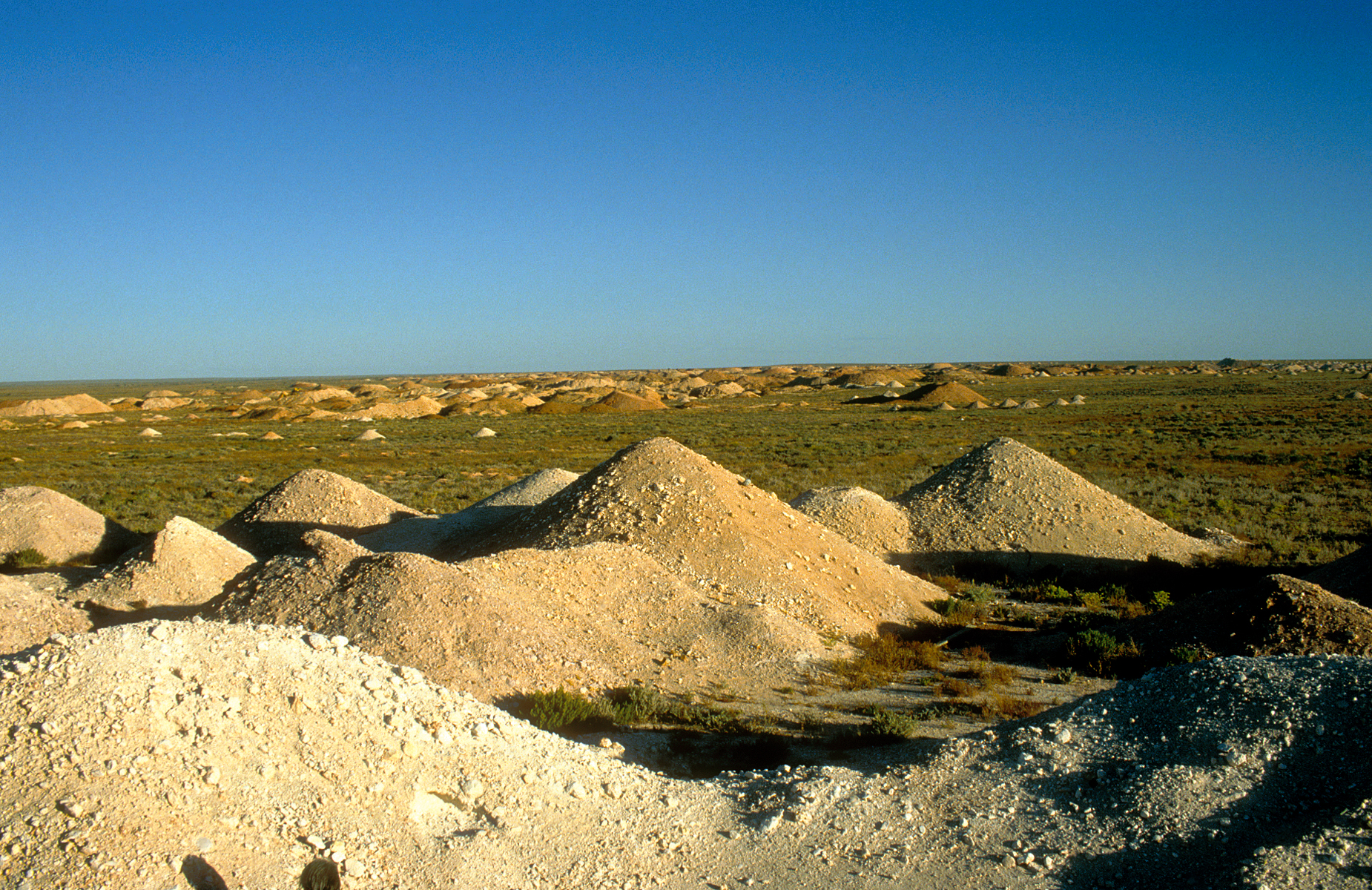
The opal is still the reason the town exists. Visitors can try "noodling" — searching through the tailings of old mines for overlooked stones — and the Old Timers Mine offers a self-guided tour through original underground tunnels, with a hard hat at the entrance and opal jewellery for sale at the exit. The Umoona Opal Mine and Museum tells the longer story, including the marine fossils from the prehistoric inland sea whose silica slowly became opal, around 150 million years ago. The desert for miles around the town is pockmarked with the mounds and shafts of countless diggings — a landscape that looks, from the air, like the surface of the Moon.
The town's most visited home belonged to Crocodile Harry, a crocodile hunter who lived underground until his death in 2006. His dugout — open to visitors — is a maze of tunnels lined with eccentric wall art, found objects, and a fake crocodile: the home of a man who treated living underground as an art form. It is the perfect summary of Coober Pedy: practical, improbable, and entirely its own.
Coober Pedy is what happens when people refuse to leave a place that is, by any ordinary measure, uninhabitable — and instead rebuild their lives a few metres down, where the earth itself does the air conditioning. The opals brought them there. The dugouts let them stay.
Related on Poptani Labs: Four Indian places that look almost unreal, The Door to Hell: the desert fire that was supposed to burn out in weeks, The navy with no sea: why landlocked Bolivia still has sailors. More in this category: Around the World.
Sources: Guinness World Records, largest underground mining town, Going, Coober Pedy: the underground opal-mining town, Ba-Ba Mail, the Australian town where people live underground

