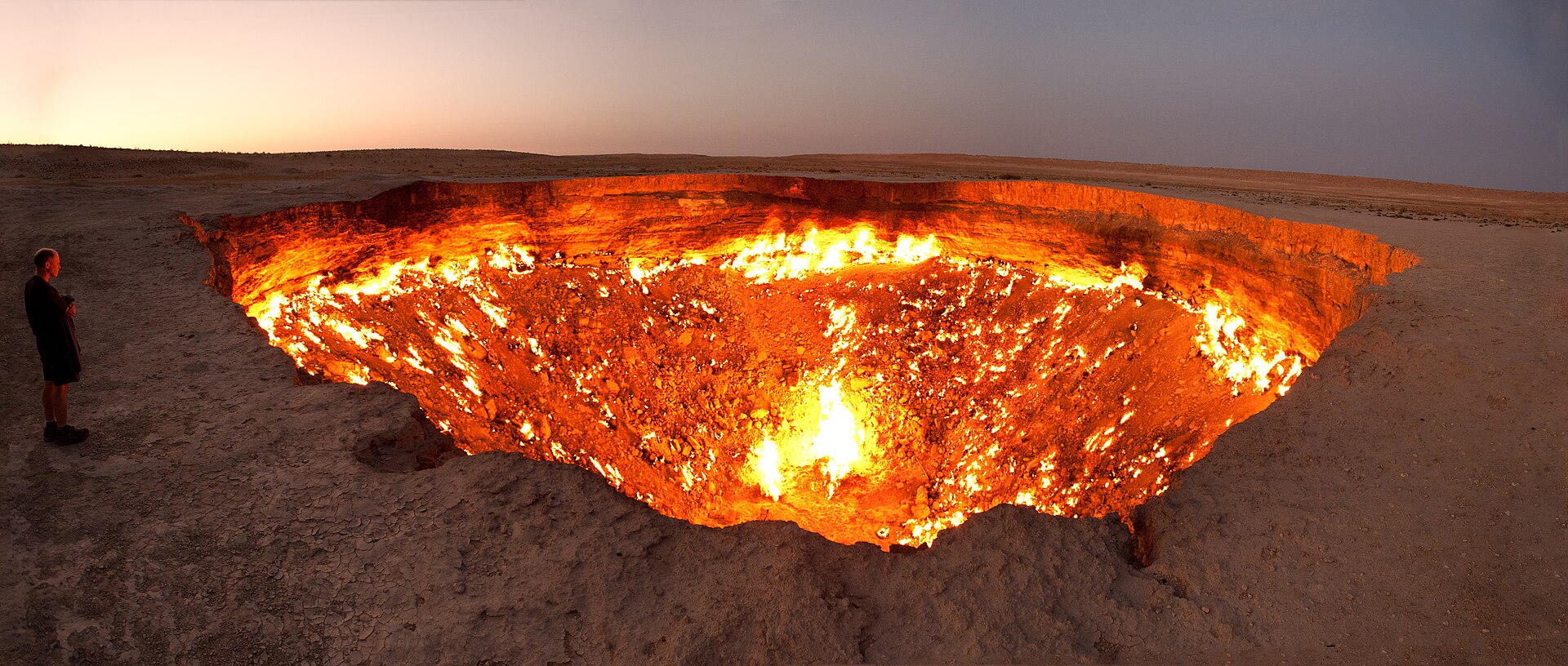
In the middle of the Karakum Desert in Turkmenistan, one of the emptiest places on Earth, there is a hole in the ground that has been on fire for most people's entire lifetimes. About 70 metres across and 20 to 30 metres deep, its floor and walls are covered in flames, and on a still night its orange glow is visible for miles across the flat black desert. Travellers call it the Door to Hell, or the Gates of Hell. The local name is simpler: Darvaza, after a nearby settlement, from a word meaning "gate". The fire was supposed to last a few weeks. It has lasted for decades — and the most interesting part of the story is how little of it we can actually prove.
The standard version goes like this. In 1971, Soviet geologists drilling for natural gas in the Karakum watched the ground collapse beneath their rig into a cavern of pressurised methane. Faced with toxic gas hissing into the air, they did the pragmatic thing: they set it on fire, expecting the flames to burn off the gas within weeks. Instead, the crater turned out to sit atop a far larger reservoir than anyone had guessed, and the methane keeps seeping up through fractured rock faster than the fire can ever clear it. The result is a permanent bonfire in the desert, roughly 260 kilometres north of the capital, Ashgabat, burning day and night for more than fifty years.
It is a great story, and it may be broadly right. But honesty is more interesting than legend here: Turkmenistan keeps no official record of the incident, and Soviet documentation from the period is patchy and was rarely made public. The 1971 date is the most widely repeated, but researchers disagree. A Turkmen geologist, Anatoly Bushmakin, suggested the collapse and the lighting may have happened closer to the early 1980s. And a 2025 study using historical Landsat satellite imagery concluded that the crater's combustion began between late 1987 and early 1988 — which, if right, would make the conventional account wrong by more than fifteen years. The crater is real, the fire is real, and the exact birthday of the flames is still an open question. That uncertainty is not a flaw in the story; it is the story, a reminder of how easily a vivid tale hardens into fact when nobody kept the paperwork.
Only one person is known to have reached the bottom. In November 2013, Canadian explorer George Kourounis descended into the crater on a National Geographic expedition, wearing a custom heat-reflective suit with breathing apparatus, lowered on steel cables into temperatures well above 1,000 degrees Celsius at the flames. He collected soil samples from the crater floor — and the laboratory analysis found specialised extremophile bacteria thriving in the methane-rich heat, life making a living in a place that looks like the textbook image of uninhabitable.
The Turkmen government has tried, on paper, more than once. In 2010, then-president Gurbanguly Berdymukhamedov ordered officials to find a way to seal the crater, citing gas that could otherwise be exported; in 2022 he ordered its closure again, this time framed as an environmental and public-health measure. Nothing happened either time. Engineers have concluded that simply backfilling the pit with sand risks pressurising the porous rock around it and causing explosive blowouts elsewhere in the desert, and the site's value as a tourist draw — one of the few things that puts Turkmenistan on a traveller's map — complicates any decision. Meanwhile, officials reported in 2025 that the blaze had dimmed dramatically, to roughly a third of its former intensity, as wells drilled nearby draw down the same reservoir. After half a century, the Door to Hell may be going out not with a grand extinguishing, but by quietly having its fuel line unplugged from the side.
The Darvaza crater is worth visiting in the imagination even if you never cross the Karakum: a place where a quick fix became a permanent landmark, where the legend outran the documents, and where bacteria live happily in the fire. If it does finally go dark, it will leave behind something rarer than a burning pit — a mystery with an ending.
Related on Poptani Labs: Four Indian places that look almost unreal, What if the Moon disappeared tomorrow?, Día de Muertos: the night the dead come home. More in this category: Around the World.
Sources: SpaceDaily, the 1971 account; ScienceBlog, on the uncertain dating and 2025 dimming; Darvaza Travel, origin facts versus legend and the 2013 expedition

