In postwar Japan, food was scarce, and Momofuku Ando could not forget a sight from the black market in Osaka: people queuing in the cold for a bowl of ramen from a street stall, waiting for a meal they could not make at home. He resolved to create ramen that could be quickly prepared and eaten at home with only hot water. It took him a year, a backyard shed, and a pan of tempura to do it — and the result, Chicken Ramen, became one of the most eaten foods in human history. This is a research-based piece: the story of an invention, told from Nissin's own history and the Japanese government's account of Ando's life.
Ando was 47 years old and, by 1957, broke. A credit union he chaired had collapsed, and he lost his property with it. He built a work shed in the backyard of his home in Ikeda, a suburb of Osaka, moved in a wok, a noodle maker, cooking oil and a bag of flour, and began experimenting alone. He worked for an entire year without taking a single day of rest, sleeping only four hours a night on average, according to the Japanese government's profile of his life. He set himself five development objectives: the noodles had to taste good enough that people would not grow tired of them, keep without refrigeration, be ready in minutes, be cheap, and be safe. Every approach he tried failed on at least one of them. Drying the noodles without breaking them seemed impossible — until his wife started frying tempura in the kitchen.
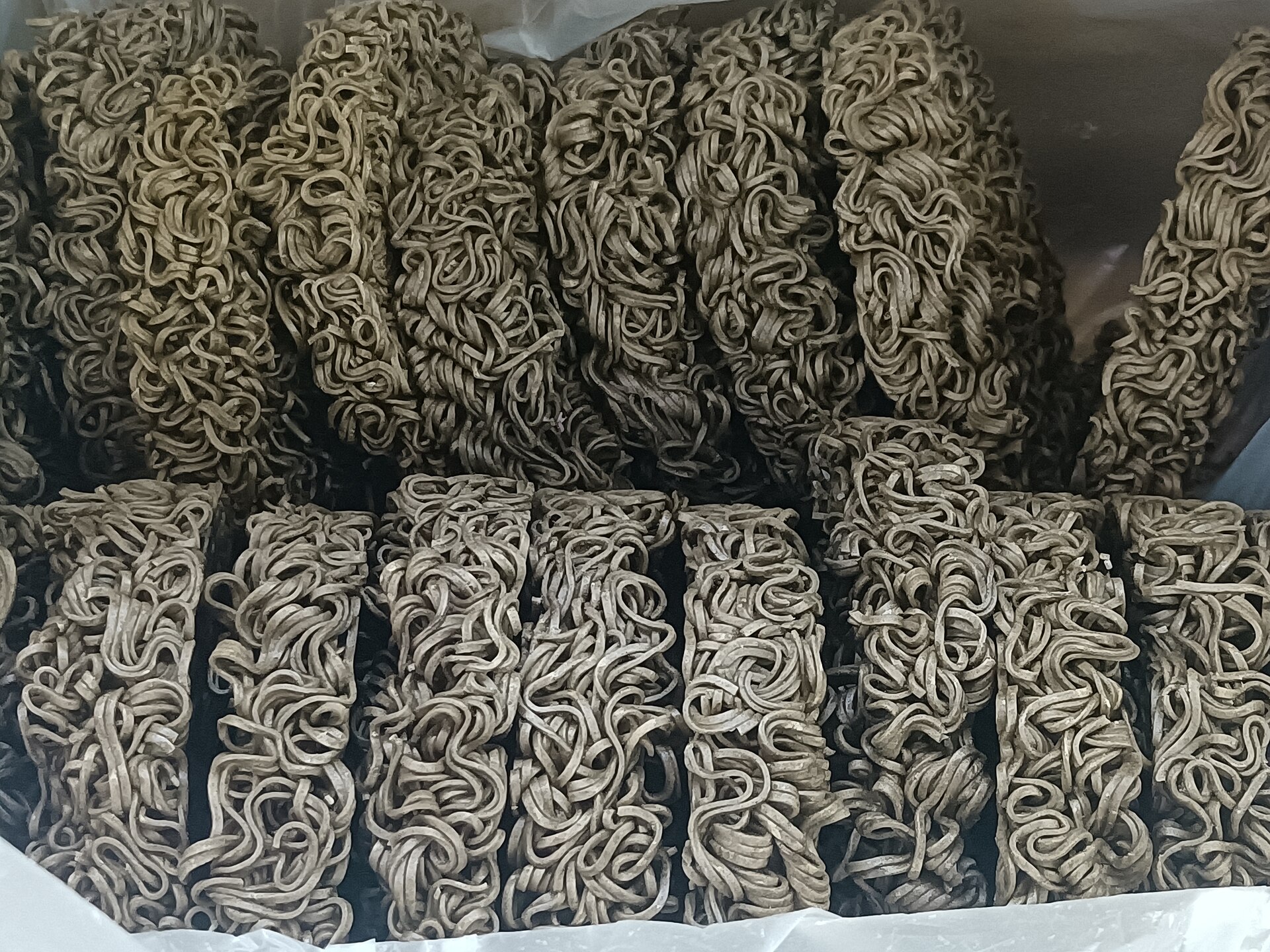
Ando was watching his wife deep-fry tempura when he noticed something: the flour coating placed in hot oil was giving off moisture, bubbling around it in the pan. The hot oil was forcing water out of the coating. He tried the same thing with noodles — frying seasoned, steamed noodles in hot oil — and found that the moisture in the noodles was forced out by the high-temperature oil, leaving behind countless tiny cavities. Pour hot water over the dried noodles and the water is absorbed through those cavities, penetrating throughout and restoring the noodles to their original softness. That was the breakthrough: flash-frying. It dehydrated the noodles so they could be stored at room temperature for months, and rehydrated them in minutes. The method was patented, and it remains the fundamental technique for producing instant noodles to this day.
On August 25, 1958, Chicken Ramen — the world's first instant noodles — went on sale. Ready to eat in just two minutes after adding hot water, it was inconceivable under the conventional wisdom of the time, and it was dubbed "magic ramen." It was not cheap: at ¥35 a pack, it cost a significant slice of a worker's daily wage of roughly ¥150 to ¥300, and it was sold as a luxury food. But it sold, and it kept selling. Thirteen years later, in 1971, Ando did it again with Cup Noodles — instant noodles in a waterproof polystyrene cup, a complete meal that needed only hot water and no bowl at all. And he never really stopped: at the age of 94, he invented Space Ram, instant noodles adjusted for eating in zero gravity, with thickened soup so it wouldn't float away and noodles sized to be eaten in a single bite. He died in 2007, aged 96, still working on food.
You can still see where it happened. The Cup Noodles Museums in Ikeda City, Osaka, and Yokohama display the history of Ando's invention, and Ikeda keeps an exact reproduction of the backyard shed — the wok, the noodle maker, the oil, the flour — where a 47-year-old man who had lost everything spent a year on a problem everyone else thought was already solved. Ando's own summary of his work was simple: he wanted to make food for people who were hungry, and he refused to believe that cheap had to mean bad. The shed is small. The idea that came out of it feeds the world.
Under the hood, instant noodles are one insight plus a year of stubbornness: fry the water out of the noodle so hot water can get back in. Ando had no noodle-making experience, no laboratory, and no money — just a shed, four hours of sleep a night, and a pan of tempura. The most useful inventions are often not the most complicated ones. They are the ones somebody refused to give up on.
Related on Poptani Labs: How a microwave oven actually heats your food (and why metal sparks), How a QR code survives scratches, smudges and a bad camera angle, QWERTY: how a 150-year-old typewriter fix still runs your keyboard. More in this category: Built in the Lab.
Sources: Nissin Foods, Our Founder — Momofuku Ando, Highlighting Japan, ANDO Momofuku, the Inventor of Instant Noodles, NoodleDex, Nissin: Top Ramen, Cup Noodles and Momofuku Ando, Taiwan Business TOPICS, Cup Noodles: A Taiwanese Legacy

