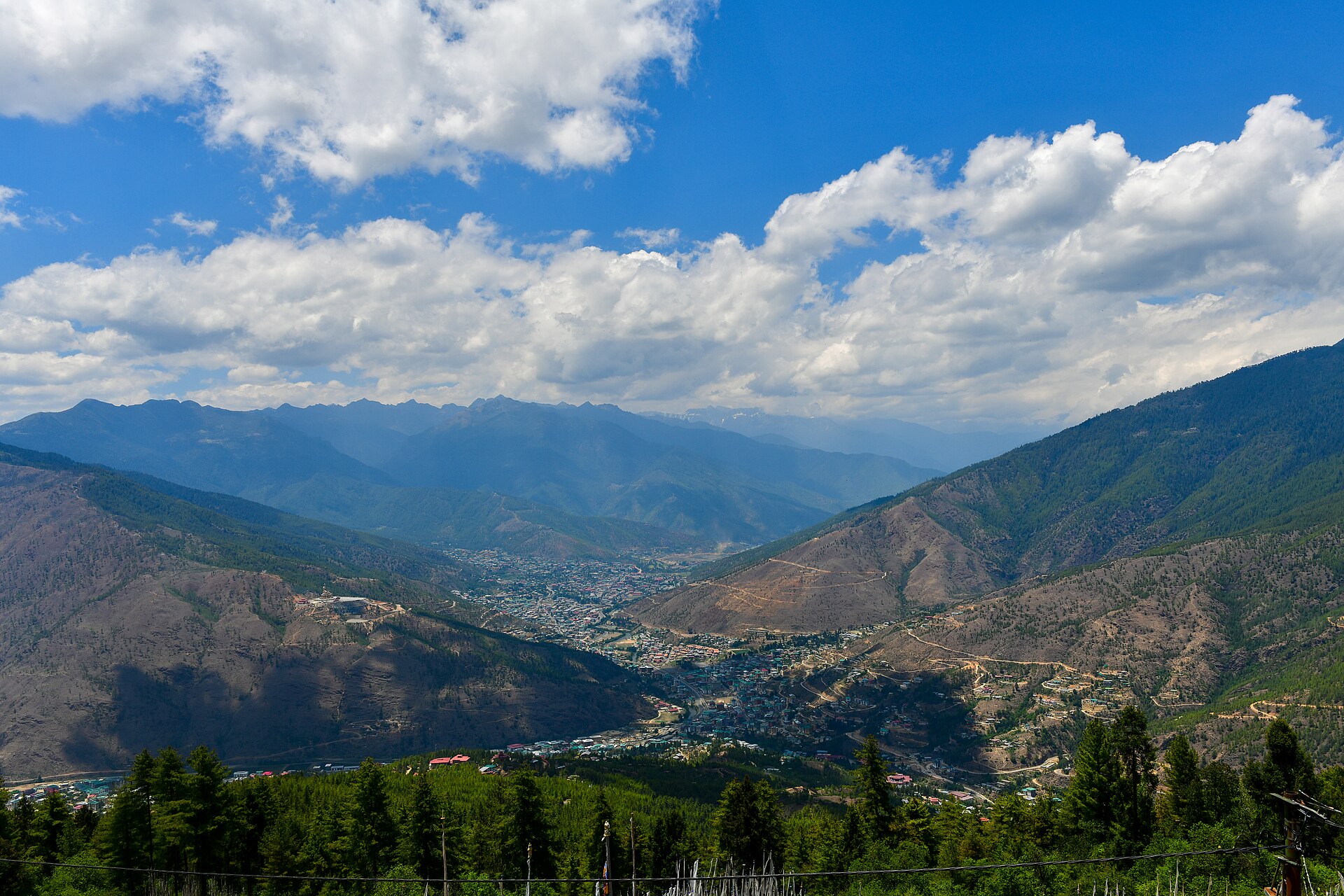
Thimphu is the capital of Bhutan, a small Himalayan kingdom that measures its progress in Gross National Happiness rather than gross domestic product. It sits at about 2,320 metres above sea level in the Wang Chhu river valley, it became the country's year-round capital only in 1961 — before that the court moved seasonally, wintering in Punakha — and it holds a distinction no other national capital can claim: it has no traffic lights. Not one. The busiest junctions in the city are managed by uniformed police officers standing in small painted booths, directing traffic by hand. This is a research-based portrait, drawn from travel writing and Bhutanese sources — not a visit, and the details below are the ones the sources agree on.
Here is the fun anecdote — the whole story, really. In the mid-1990s, the city tried a traffic light. One was installed at the central Norzin Lam junction as a pilot, in 1995 by most accounts. The public reaction was immediate and overwhelmingly negative. Residents called the light impersonal, cold, and ugly — a machine replacing a human being they knew. Sources differ on the exact duration — some say 24 hours, others a few days — but they agree on the outcome: the light was taken down, the policeman came back, and no second attempt has ever been made at that junction. As of 2026, there is still no installation planned there. One visitor, watching the officer at work, described it as "like seeing a ballet dancer in action — no sound, just gentle flowing movements, which the public obediently followed". The city did not reject the traffic light because it failed. It rejected it because it worked, and the people preferred the human being anyway.
What replaced the light is not chaos but choreography. At Thimphu's major intersections, traffic police in sharp uniforms and white gloves stand in colourful wooden gazebo-style booths and direct vehicles with smooth, deliberate hand gestures — a system that has run, more or less unchanged, since before the light was ever tried. It works because Thimphu is small: a city of roughly 115,000 people, with traffic volumes far below those of other capitals, and with roundabouts doing much of the work the lights would otherwise do. The officers are a familiar sight, and for visitors they have become one of the city's landmarks — photographed as often as its temples and its giant Buddha statue, the 51-metre gilded figure that watches over the valley. The arrangement is sometimes misreported as a country-wide ban. It is not: some signal infrastructure has appeared in other Bhutanese towns, notably Phuentsholing on the southern border. The accurate claim is the narrower one, and it is striking enough on its own — the capital, and only the capital, runs entirely on hand signals.
The traffic light is a small story, but it sits inside a larger one about how Bhutan has chosen to modernise. Television arrived only in 1999. Democracy arrived in 2008. The constitution requires forest cover to stay above 60%. Development is officially measured in well-being, culture, environment, and governance, not in output alone. None of that means Bhutan is frozen in time — Thimphu has cars, smartphones, and rush hour, and its police do review whether signals might be needed during peak tourist seasons, when foreign drivers are unfamiliar with the hand choreography. But the 1995 decision has held for thirty years, and the reason it has held is the one the residents gave at the time: a traffic light is impersonal, and in a city small enough to run on a familiar face, impersonal was not an improvement. The light was not too advanced for Thimphu. It was too cold for it.
Thimphu's missing traffic lights are not a quirk to photograph and move on from — they are a decision, made in public, about what a city is for. Most capitals automate their junctions and never think about it again. Thimphu tried automation, listened to the people who actually use the junction, and chose the human being in the booth. Thirty years later, the booth is still there, the gestures are still elegant, and the only capital in the world without a traffic light is still running on time — one wave at a time.
Related on Poptani Labs: Baarle: the town where the border runs through your front door, Giethoorn: the Dutch village with no roads — only canals, Longyearbyen: the Arctic town where you're not allowed to die (almost). More in this category: Around the World.
Sources: Thimphu and the question of traffic lights (BhutanWiki), A country without traffic lights? There's only 1 left (Jalopnik), This serene capital city has zero traffic lights and locals love it (Wego), Thimphu, Bhutan — the world's only capital city with no traffic lights (The A to Z Journey)

