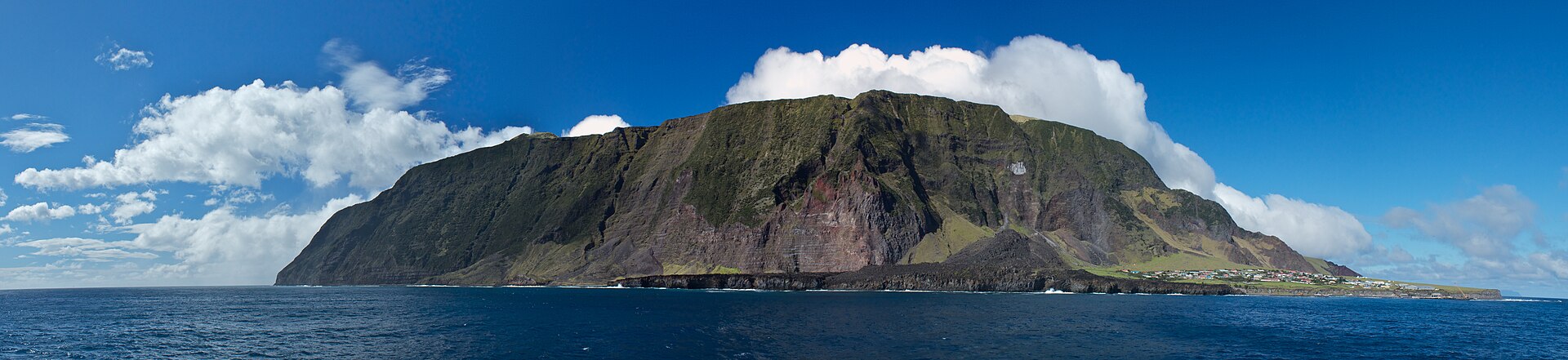
There is a place on Earth where the nearest inhabited land is 2,430 km away, the nearest continent is 2,816 km away, and getting there takes six days by boat — because there is no airport, and there never has been. Tristan da Cunha is a volcanic island in the middle of the South Atlantic, home to about 220 people (221, in the 2026 census), all living in a single settlement with one of the grandest names in geography: Edinburgh of the Seven Seas. It is, by the usual reckoning, the most remote inhabited island in the world. This is a research-based portrait, drawn from the island's own history pages and reference sources — no visit, no first-hand account, and no claim to have been there.
The main island is about 11 km across and 98 square kilometres, and almost all of it is a volcano: Queen Mary's Peak rises 2,062 metres, high enough to hold snow in winter. The only flat ground is a strip on the north-west coast, and that is where everything is — the settlement, and the farming area called the Potato Patches. Everyone on the island holds British Overseas Territories citizenship, and the island's life runs on what it can grow, catch and make: the lobster cannery was the economic heart of the place. There is no mobile phone network — a visitor loses signal days before arriving, somewhere after losing sight of Cape Town. The island has its own radio station, a post office that doubles as the visitor centre, and a way of life that is self-sufficient because it has to be: when the next supply ship is a week away and the weather decides whether it can land, you keep spares of everything.
Here is the fun anecdote — the time the whole island had to leave, and then voted to come back. There had been no recorded volcanic activity in the island's human history, but in August and September 1961 the ground began shaking, and landslides fell behind the settlement. On the morning of 9 October a fissure opened between the settlement and the cannery, and the ground rose into a new volcanic cone. On 10 October all 264 islanders were evacuated: first in the local lobster boats to uninhabited Nightingale Island for the night, then aboard a Dutch passenger ship, the Tjisadane, which happened to be passing to pick up two Tristan girls for nurse training in Cape Town. From there they sailed to England on the liner Stirling Castle, arriving in Southampton on 3 November to a crowd of reporters, and were housed in an old RAF camp at Calshot, in houses on a road still called Tristan Close. The government assumed the evacuation was permanent. The islanders had other ideas: they were given lectures on electric cookers and washing machines, their children went to local schools, and many found work — but they missed home. In December 1962 the community held a ballot on whether to return. Just five votes were cast against leaving Hampshire. An advance party went back in April 1963, and most families followed that November, to a settlement that had survived and a volcano that had gone quiet.
Sixty years later, the same remoteness did something no other place on Earth managed. When the pandemic reached the world in 2020, Tristan's Island Council banned all outside visitors on 16 March 2020 — and because the island has no airport and only a six-day boat journey from South Africa, enforcing the ban was simple. Daily life in Edinburgh of the Seven Seas continued as usual, without masks, social distancing or closures. The island recorded zero community cases of COVID-19, and only lifted its remaining travel restrictions in March 2023, after a full booster campaign. It remains a unique example of a perfect geographic quarantine — the one place where isolation, usually the island's biggest problem, turned out to be its best defence.
Tristan da Cunha is a reminder that remoteness is not only a hardship. The same six-day boat ride that makes everything harder — supplies, medical care, a trip to anywhere — is what kept a volcano evacuation orderly, what let a community vote its way home, and what kept a pandemic out entirely. About 220 people live on a volcano in the middle of an ocean, by choice, on an island most of the world could not find on a map. They seem in no hurry to be anywhere else.
Related on Poptani Labs: Longyearbyen: the Arctic town where you're not allowed to die (almost), Whittier, Alaska: the town where almost everyone lives in one building, Thimphu: the capital city with no traffic lights. More in this category: Around the World.
Sources: Tristan da Cunha (Wikipedia), Tristan da Cunha Volcanic Interlude 1961–1963 (tristandc.com), The Evacuation of Tristan da Cunha (History Today)

