Stars do not simply blink out of existence — matter and energy do not vanish. But as a thought experiment, the Sun disappearing is one of the most revealing questions in physics, because the answer is not "everything ends instantly". It is a precise timetable. The parts below that describe established physics are solid; the parts that describe the far future are models, and different models disagree on the exact numbers. Here is the timetable.
Sunlight takes about 8 minutes and 20 seconds to cross the roughly 150 million kilometres between the Sun and Earth. And gravity, as NASA explains, also propagates at the speed of light. So for the first 8 minutes and 20 seconds after the Sun vanished, absolutely nothing on Earth would change: the sky would stay bright, the weather would keep moving, and Earth would keep tracing its usual orbit around a Sun that was already gone. Then, in a single instant, the last sunlight would arrive and the loss of gravity would arrive with it. The dayside sky would snap to black, the stars would come out at noon, and the Moon would go dark too, since it only shines by reflected sunlight.
Without the Sun's gravity bending its path into a circle, Earth would keep the speed it already has — about 30 kilometres per second — but stop curving. It would fly off in a straight line, tangent to its old orbit, like a stone released from a sling. Nobody would feel a jolt, because the whole planet would coast together at the same velocity. From then on Earth would be a rogue planet, drifting through interstellar space, gradually approaching whatever stars happened to lie along its path. The nearest, Proxima Centauri, is about 4.2 light-years away — a journey of tens of thousands of years at 30 kilometres per second, in the dark.
Darkness would not mean an instant deep freeze. Rocks, oceans and air hold an enormous amount of heat and release it slowly. Surface temperatures would fall below freezing within about a week, according to MIT atmospheric scientist Timothy Cronin, quoted in recent coverage of the scenario. Within months they would plunge far below anything recorded on Earth, and within about a year toward minus 100 degrees Fahrenheit. Photosynthesis would stop almost at once, collapsing the base of nearly every surface food chain. The oceans would freeze from the top down — but that ice would act as insulation, and a 2002 study in Geophysical Research Letters found it would take at least a decade for the ocean to cool to seawater's freezing point. Given enough time, the air itself would grow cold enough for carbon dioxide to fall as dry-ice snow. The planet would not freeze solid quickly, but it would become uninhabitable at the surface within weeks.
Life would not end everywhere at once. Deep below the seafloor and inside Earth's crust, whole communities of microbes already live without any sunlight, fed by chemical energy from the planet's interior. Geothermal heat would keep some deep refuges warm for a very long time. Humans, though, would face a harder problem: our food, our power grids and our heating all ultimately trace back to the Sun. A small number of people near geothermal heat, with stockpiled supplies and sealed habitats, might last longer than anyone else — but this is speculation, not a survival plan. The honest answer is that surface civilisation ends with the sunlight, and only the deep, dark biosphere carries on.
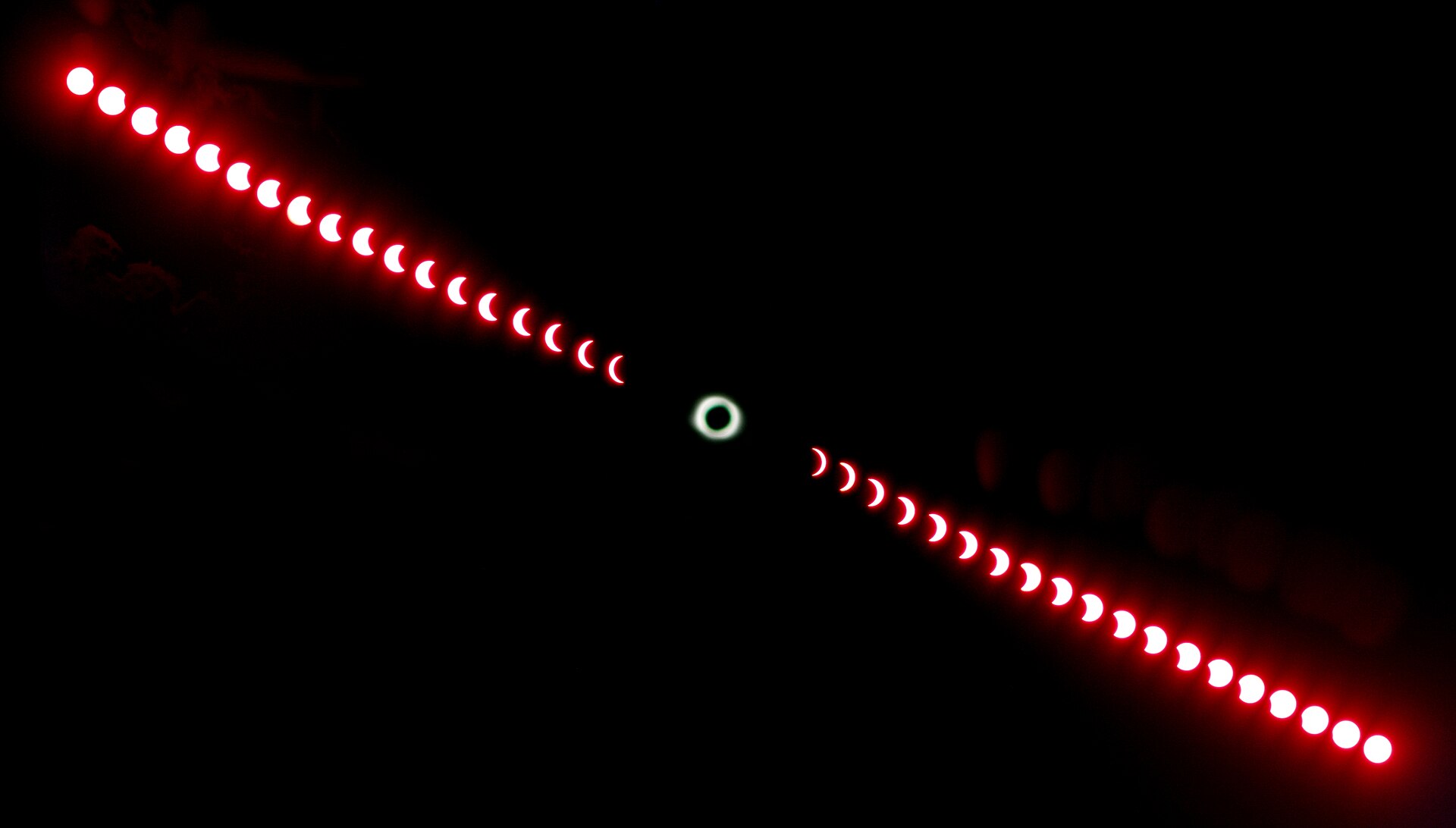
The strangest part of this scenario is that the Sun's light and gravity travelling at the same speed is not just theory — it was tested by an eclipse. On May 29, 1919, Arthur Eddington led an expedition to the island of Príncipe, off West Africa, while a second team went to Sobral in Brazil, to photograph stars near the eclipsed Sun and check whether their light bent by the amount Einstein's general relativity predicted. Clouds plagued Eddington's team and only two of his plates were usable, but Sobral produced seven good ones, and together they confirmed Einstein's prediction: the Sun's mass really does bend starlight. The same physics that bent starlight in 1919 says we would keep orbiting a vanished Sun for exactly 8 minutes and 20 seconds — and then, all at once, stop.
The real Sun is going nowhere in a hurry. It will keep shining steadily for billions of years before swelling into a red giant near the end of its life. The disappearing-Sun scenario is impossible, but it is useful precisely because it is impossible: it forces you to see how many separate things — light, gravity, climate, food, the Moon in the night sky — all trace back to one star, 150 million kilometres away, whose light is always eight minutes old. Every sunset you have ever watched left the Sun eight minutes earlier. You have been living on delayed light all along.
If the Sun vanished, the first thing we would lose is not warmth but information — eight minutes of light and gravity still travelling toward us from something already gone. The deeper question the scenario asks is how much of ordinary life is borrowed energy, arriving late, from a star we rarely think about.
Related on Poptani Labs: What if the Moon disappeared tomorrow?, What would happen if the internet disappeared tomorrow?, Carl Sagan and the pale blue dot: the photo that shrank the world. More in this category: What If?.
Sources: WorldAtlas, what would happen if the Sun disappeared; NovaKnown, how long Earth would take to cool; Space.com, the 1919 eclipse that confirmed Einstein

