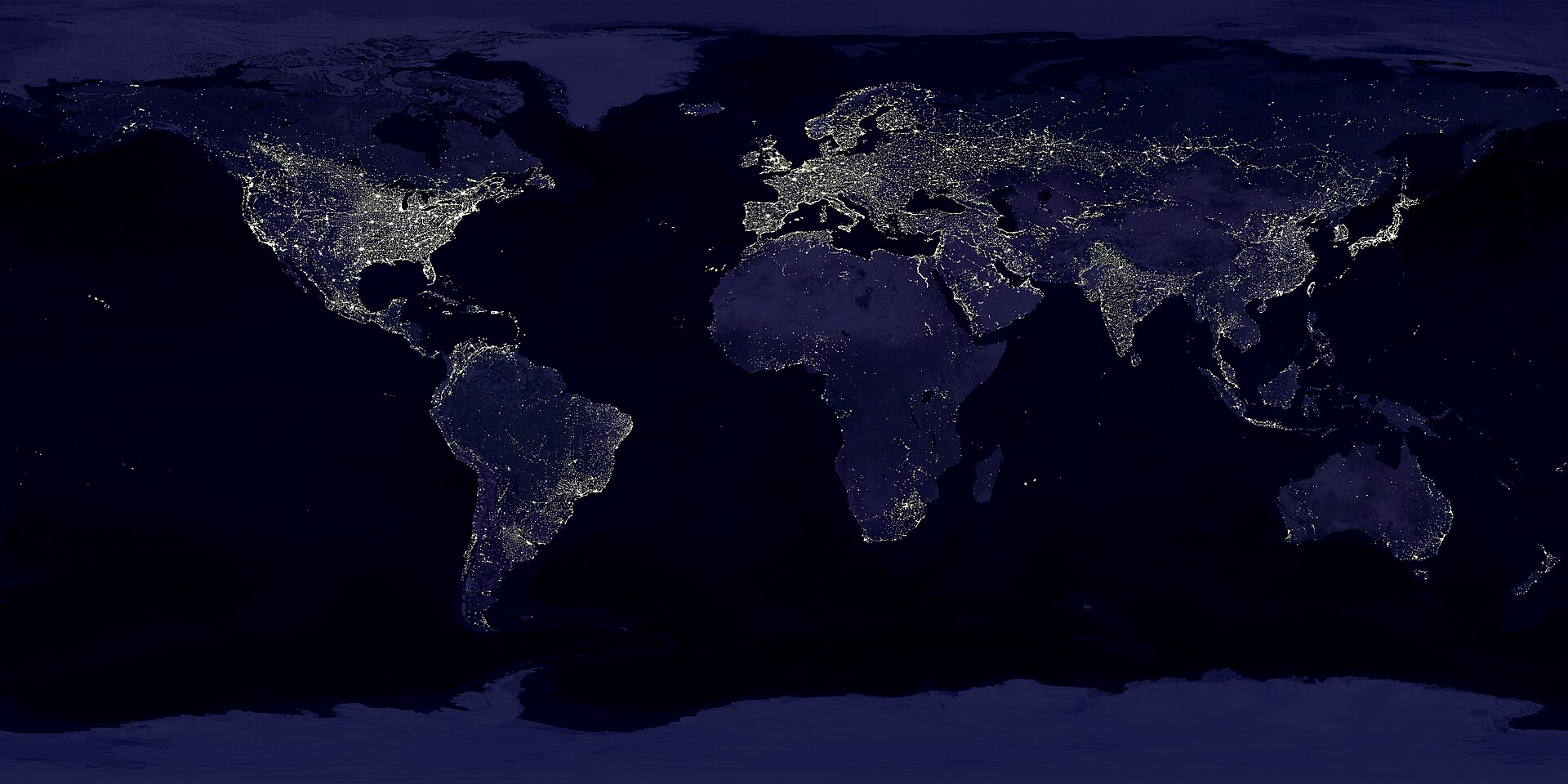
Right now, the ground beneath you is moving east at roughly 1,600 kilometres an hour — faster than a passenger jet — and you can't feel a thing, because everything around you is moving at the same speed. Earth has been spinning since it formed, and nothing in nature could stop it. But as a thought experiment, it's a good one: what if it did stop? The answer comes in two versions — a sudden stop and a slow one — and both are stranger than you'd expect.
Stop the ground and everything not bolted to it keeps moving, thanks to inertia — the same reason a passenger lurches forward when a car brakes. At the equator, the ground moves at about 1,040 miles per hour (1,674 km/h), and the air, the oceans, the trees, the buildings and you would all keep going east at that speed. The Smithsonian's James Zimbelman put it bluntly: the momentum would scour the surface, rip it apart, and send shards into the upper atmosphere. Winds over 1,600 km/h would strip away anything not anchored to bedrock; oceans would surge eastward in waves far worse than any tsunami. Only near the poles would you be safe-ish: within about seven miles of the pole, the ground barely moves, and you'd stumble forward at walking speed. Everyone else would be thrown.
A gradual stop, over years or longer, spares you the flying debris — but the planet it leaves behind is unrecognisable. Earth's spin creates a centrifugal bulge that pushes the oceans toward the equator. Take the spin away and the water drifts to the poles. In a 2010 model by Witold Fraczek of the mapping company Esri, the result is two polar oceans and a belt of dry land around the equator, with ocean depth dropping by about 8 kilometres at the equator. And the day would stretch: with no spin, one full cycle of day and night would take about a year — six months of unbroken sunlight roasting one side while the other freezes in six months of dark. Winds would whip across the terminator, the line between light and dark, as cold air rushed back from the night side. The Coriolis effect would vanish, ending the trade winds and jet streams — and hurricanes could no longer form.
Rotation does more than set the length of the day. Deep in Earth's liquid outer core, molten metal swirls — and the spin organises that swirling into electric currents that generate the magnetic field, a process called the geodynamo. Stop the rotation and the dynamo winds down; the magnetic field weakens and fades. Without it, the solar wind would slowly strip the atmosphere away, the way it did on Mars. GPS would fail within hours — the whole system is calibrated for a rotating planet.
Here's the part that really happened. On March 11, 2011, a magnitude 9.0 earthquake struck off Japan — the fifth largest since 1900. It moved parts of Japan by as much as 4 metres and redistributed so much of Earth's mass that, according to NASA's Richard Gross, it sped the planet up slightly: each day got about 1.8 microseconds shorter, and Earth's figure axis — the line its mass balances around — shifted by about 17 centimetres. A microsecond is a millionth of a second, so nobody noticed; but the measurement is real, and it's a reminder that Earth's spin is not a fixed number. It's a balance, and anything that moves enough mass moves the balance. The 2004 Indonesian quake did the same thing, shortening the day by an estimated 2.68 microseconds.
Not suddenly, and not soon. The Moon's gravity does drag on Earth's spin — tidal braking lengthens the day by about 2.3 milliseconds a century, according to NASA — but at that pace, stopping would take billions of years, and the Sun will have other plans by then. As Zimbelman put it, there is no natural force that would stop the Earth from spinning, which is part of why it has been spinning since it formed. The thought experiment is safe to run in your head. It is not going to happen in your lifetime.
The spin you can't feel is doing quiet work all the time: holding the oceans at the equator, driving the winds, powering the magnetic shield, and setting the length of your day. Stop it suddenly and everything flies apart; stop it slowly and the planet rearranges itself into something unrecognisable. The most ordinary thing about Earth — that it turns — turns out to be load-bearing.
Related on Poptani Labs: What if the Moon disappeared tomorrow?, What if the Sun disappeared tomorrow?, What would happen if the internet disappeared tomorrow?. More in this category: What If?.
Sources: Space.com, What would happen if Earth suddenly stopped spinning?, ScienceAlert, What Would Happen if Earth Suddenly Stopped Spinning?, NASA JPL, Japan Quake May Have Shortened Earth Days, Moved Axis, Pippa's World, What If the Earth Stopped Spinning?

